

12th Feb.2026
Explore More BlogsPractical steps for school leaders to turn CO-PO mapping into a manageable, auditable system using curriculum management and curriculum mapping software. Covers why mapping matters, how software reduces risk and teacher workload and an implementation checklist administrators can use today.
Inside this Blog:
- Why CO-PO Mapping Matters and Why Administrators Worry About It
- How Curriculum Mapping and Curriculum Management Differ and Why You Need Both
- Practical Benefits of Using Curriculum Mapping Software for CO-PO Alignment
- A Step-by-step Admin Playbook
- Common Implementation Pitfalls and How to Avoid Them
- What Stakeholders Actually Expect to See
- Frequently Asked Questions (FAQs) About CO-PO Mapping
- A Short Checklist for School Leaders
- See how this works in practice.
A sudden accreditation visit, a request for evidence that “shows where learning happens,” or a teacher asking which year a specific skill is introduced. Every school leader has been there. Those moments expose a familiar truth that good intentions don’t equal visible alignment. For busy leaders trying to protect instructional time, CO-PO mapping (Course Outcomes, Program Outcomes) is more than a technical exercise; it’s the bridge between classroom practice and school-level accountability.
When done well and supported by modern curriculum management tools, mapping stops being a paperwork sprint and becomes a living system that improves instruction, reduces risk and makes accreditation straightforward. That’s the kind of practical, teacher-friendly approach Edusfere champions – systems that help, not burden, educators.
Why CO-PO Mapping Matters and Why Administrators Worry About It
CO-PO mapping is the technical way schools show that course-level learning leads to program-level outcomes like skills, dispositions and competencies graduates must demonstrate. For administrators, the stakes are real. Accreditation reviewers want evidence that learning is coherent across years and that standards are implemented, assessed and improved. When mapping lives in spreadsheets, gaps and redundancies hide; when it lives in a curriculum management platform, alignment becomes auditable and continuous.
Accreditation bodies increasingly expect demonstrable links between intent, instruction and assessment; not a folder of static documents.
Key problems mapping must solve include:
- Hidden gaps between what’s written in standards and what is actually taught.
- Redundant teaching where the same standard is covered repeatedly without progression.
- Lost institutional knowledge when teachers or leaders leave.
- Time-heavy evidence collection during audits or accreditation visits.
How Curriculum Mapping and Curriculum Management Differ and Why You Need Both
Before choosing tools, it helps to separate two related ideas. Curriculum mapping is the what, when and how a map showing where each standard, outcome and assessment appears across grades and courses. Curriculum management is the system that maintains, governs and reports on those maps (workflows, versioning, access control and analytics).
Together they enable both instructional coherence and compliance. And here’s why combining them matters:
- Curriculum mapping without management becomes stale. A map is useful only if it’s kept current.
- Curriculum management without clear maps gives administrators oversight but no instructional detail.
- The right platform ties lesson plans, assessment evidence and CO-PO matrices together so reviewers see both intent and classroom practice in one place.
Practical Benefits of Using Curriculum Mapping Software for CO-PO Alignment
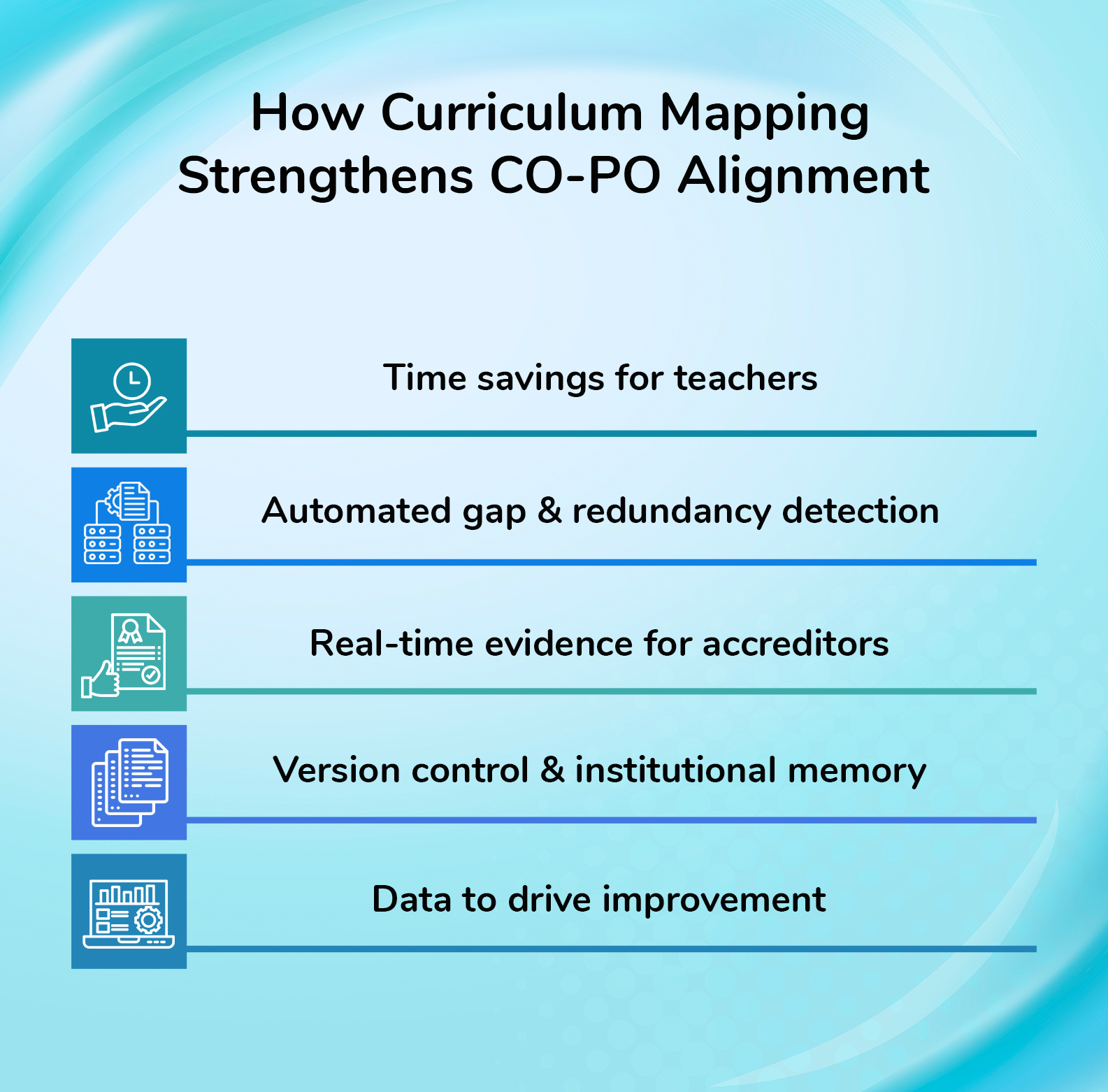
Administrators often ask “what will this actually save us?” Beyond compliance, curriculum mapping software frees time, reveals gaps and converts anecdotes into data. Recent practitioner guides and vendor ROI analyses show measurable gains in time saved, improved coverage rates and clearer accreditation evidence.
Some of the primary benefits include:
- Time savings for teachers Automated templates and linked lesson plans cut planning hours each week.
- Automated gap & redundancy detection Software flags missing standards or overlapping coverage so leaders can act early.
- Real-time evidence for accreditors Pullable reports show where outcomes are taught, assessed and evidenced.
- Version control & institutional memory Historical records protect schools from knowledge loss during staff turnover.
- Data to drive improvement Alignment scores, coverage rates and teacher usage metrics help prioritize professional development.
Curious what streamlined CO-PO mapping looks like in action?
Schedule a personalised Edusfere demo to see how curriculum mapping, lesson planning and outcomes tracking come together in one clear, audit-ready system.
A Step-by-step Admin Playbook: Turn CO-PO Mapping into an Auditable Routine
The transition from scattered documents to a robust, auditable system can be managed in phases. Below is a pragmatic roadmap administrators can follow in 6-12 months, with checkpoints for teachers, curriculum leads and school leaders.
Clarify outcomes & standards
- Inventory program outcomes (POs) and course outcomes (COs). Make wording consistent and measurable.
- Keep a single source of truth (not a dozen spreadsheets).
Choose a platform that links maps to lesson plans
Prioritize platforms that let you attach assessment evidence and lesson plans to specific COs/POs. Look for versioning and exportable reports. See Edusfere’s approach to unifying maps, lesson plans and standards.
Pilot with one department
Run a 6-8 week pilot with one subject or grade, use real lessons and assessments. Gather teacher feedback.
Set metrics & governance
Track alignment score, coverage rate, teacher planning time saved and accreditation incidents. Make a small governance team to approve CO changes.
Train and Scale
Short, focused PD sessions; show teachers how mapping saves time by reducing duplicated planning. Incentivize completion with release time or recognition.
Make it Accreditation-ready
Create a standing accreditation folder that exports standards coverage, CO-PO matrices and linked lesson evidence for reviewers.
Common Implementation Pitfalls and How to Avoid Them
Even with the right tool, leaders fall into recurring traps that limit impact. Anticipating these problems prevents months of rework.
- Treating mapping like a one-off project
Solution: Schedule quarterly reviews and tie mapping to PD cycles.
- Over-specifying CO language
Solution: Keep COs measurable but pragmatic; teachers should recognise them in everyday planning.
- Picking tools with poor UX
Solution: Pilot for teacher usability and monitor early adoption metrics.
What Stakeholders Actually Expect to See
As curriculum alignment moves from classrooms to leadership discussions, expectations become more concrete. School boards, accreditation panels and academic leadership teams are not looking for narrative explanations of alignment, they want operational clarity. Specifically, they want to see whether outcomes alignment can be reviewed, monitored, and validated without placing additional strain on teachers or administrators.
At this stage, effective CO-PO mapping is less about individual lesson plans and more about systems. Stakeholders expect administrators to be able to produce clear reports that show where outcomes are introduced, reinforced and assessed across programs or grade levels.
Dashboards that surface gaps, overlaps and progression patterns provide confidence that alignment is being actively managed, not retrospectively assembled.
Workflows matter just as much as visibility.
Leaders want to know how curriculum updates are approved, how changes are tracked over time and how consistency is maintained when teachers rotate or syllabi evolve. Without defined workflows, even well-designed curricula become difficult to govern and harder to defend during reviews.
When curriculum mapping software like Edusfere integrates reporting, dashboards and approval workflows into everyday curriculum management, alignment becomes operationally reliable. Evidence is available on demand, reviews are routine rather than reactive and compliance becomes a by-product of good instructional governance, not a last-minute scramble.
See how schools are simplifying alignment without adding teacher workload. Book a live Edusfere walkthrough to explore real dashboards, reporting workflows, and accreditation-ready curriculum views in action.
Frequently Asked Questions (FAQs) About CO-PO Mapping
- What is CO-PO mapping?
CO-PO mapping links measurable Course Outcomes (COs) to broader Program Outcomes (POs) so schools can demonstrate how courses cumulatively deliver program goals and competencies.
- Do I need special software for CO-PO Mapping?
You can map manually, but curriculum mapping software centralizes the maps, links lesson plans and assessment evidence, and makes audits faster and less disruptive.
- How long does it take to implement Curriculum Mapping Software?
Getting up and running can take as little as a couple of weeks, while full curriculum capture depends on scale and governance.
- Will mapping improve student outcomes?
Mapping itself is a system; its power comes when combined with regular review, targeted PD and data-driven adjustments. And then it helps close gaps and improve progression.
A short checklist for school leaders
If you remember only three things from this guide, let them be these: clarity, systems and people.
- Capture COs and POs in one definitive document.
- Use a curriculum management platform that links maps, lesson plans and evidence.
- Track a few meaningful metrics (alignment score, planning time saved, coverage rate) and review quarterly.
When CO-PO mapping is built into daily workflows and supported by intelligent curriculum management, it stops being a compliance nightmare and becomes a leadership advantage with clearer instruction, less waste and a stronger case for accreditation. If you want, start with a single pilot department this term and build a concise evidence bundle for your next review.
See how this works in practice.
Edusfere helps schools turn CO-PO mapping into a clear, governed and accreditation-ready system through live dashboards, structured workflows and evidence-ready reports.