

Key Takeaways
- Move beyond static curriculum maps. Use connected systems to manage curriculum across grades, subjects and courses.
- Keep biblical worldview at the center. Technology should support the school's educational philosophy, not define it.
- Strengthen curriculum alignment. Use curriculum data to identify gaps, overlaps and progression issues.
- Make accreditation evidence ongoing. Keep curriculum documentation current instead of rebuilding it before an ACSI review.
- Reduce teacher workload. Good curriculum software should eliminate duplicate documentation and simplify planning.
- Use curriculum data to improve. Look beyond compliance. Use curriculum insights to guide real instructional decisions.
- Choose technology around your needs. Start with curriculum goals, then select tools that support them.
- Consider connected curriculum management. Edusfere brings curriculum mapping, lesson planning, standards alignment, resources and curriculum visibility together in one platform.
For schools pursuing or maintaining ACSI accreditation, curriculum mapping sits at the intersection of several priorities that school leaders cannot afford to treat separately. Curriculum needs to be coherent across grade levels, aligned to appropriate standards and learning outcomes, documented clearly and reviewed as the instructional program evolves. At the same time, the curriculum needs to remain faithful to the school's educational philosophy and bible based teaching. That combination makes curriculum management more demanding than simply maintaining a collection of curriculum maps.
Many schools are now moving away from spreadsheets, static documents, and disconnected files toward centralized curriculum management platforms. The shift is not simply about replacing paper with software. It reflects a broader change in how schools think about curriculum; from something that is documented periodically to something that is continuously reviewed, connected and improved.
For ACSI schools in particular, that modernization presents an important opportunity. Technology can make the curriculum easier to see and manage without becoming the thing that determines what the school values. The most effective approach is therefore not technology-first. It is mission-first, curriculum-first and then technology-enabled.
ACSI and Edusfere: A Partnership Built Around Curriculum Management
Edusfere's work with ACSI goes beyond a typical technology partnership. Edusfere is the officially recommended curriculum mapping and management partner for ACSI schools, working closely with ACSI leadership and its accreditation team. More than 75 ACSI schools are currently using Edusfere to streamline their curriculum management processes.
That ongoing relationship gives Edusfere a direct understanding of the curriculum challenges schools encounter as they prepare for accreditation, maintain curriculum documentation and build systems for continuous improvement. Regular engagement with ACSI's leadership and accreditation teams also helps keep Edusfere closely connected to the evolving needs of ACSI schools.
For schools modernizing their curriculum processes, that context matters. Curriculum management is not just about storing maps or aligning standards. It needs to support the school's educational philosophy, provide meaningful visibility for leaders and teachers and make curriculum evidence easier to maintain throughout the accreditation cycle.
This is where a purpose-built curriculum management platform can make a difference. The technology should support the school's mission and accreditation work without turning either into a compliance exercise.
Why Curriculum Mapping Matters More for Mission-Driven Schools
Curriculum mapping gives school leaders a way to see whether the intended curriculum is actually coherent across the student experience. Without that visibility, even strong teachers and well-designed individual courses can produce a curriculum that contains gaps, unnecessary repetition or inconsistent expectations from one grade to another.
This becomes particularly important for ACSI schools because curriculum does not exist independently of the school's broader educational purpose. ACSI's accreditation framework considers the relationship between a school's philosophy, mission, vision, core values, expected student outcomes and educational programs. Curriculum documentation and review therefore have significance beyond demonstrating what teachers cover. A strong curriculum map can help leaders examine several dimensions at once:
- What students are expected to learn
- How knowledge and skills develop across grades
- Where standards and learning outcomes are addressed
- How assessments measure intended learning
- Where curriculum gaps or redundancies exist
- How instructional priorities are reflected across the program
- What changes have been made as part of continuous improvement
This makes curriculum mapping a leadership tool as much as a teacher-planning tool. The underlying question is not simply, "Have we mapped the curriculum?" It is whether the school can explain how its curriculum works as a coherent whole and how it continues to improve.
The Challenge: Most Schools Have Curriculum Data But It’s Disconnected
The difficulty facing many schools today is not a lack of information. It is the amount of information spread across different places and systems.
A curriculum director may maintain standards documentation in a spreadsheet while teachers keep unit plans in shared folders. Course descriptions may live on a school website, assessments in a learning platform, instructional resources somewhere else and curriculum review notes in meeting documents. Individually, these resources may be perfectly useful. Collectively, they make it difficult to answer relatively straightforward leadership questions.
What is being taught across the school? Where does a particular standard appear? Are students building on prior learning? Which concepts are being repeated? Where are students expected to demonstrate a skill that has not yet been sufficiently developed?
The administrative cost of this fragmentation can be significant. Curriculum leaders often end up spending valuable time locating, comparing, updating and reconciling information rather than using it to make curriculum decisions. It also creates a maintenance problem. A curriculum map that is accurate when it is submitted for review can become outdated quickly if there is no practical process for keeping it current.
This is why the modernization of curriculum mapping is increasingly becoming a question of curriculum management, rather than simply better mapping templates.
From Static Curriculum Maps to a Living Curriculum
The traditional curriculum map is often treated as a finished document. A teacher completes it, a curriculum leader reviews it, and the school stores it until the next major curriculum review or accreditation cycle. A modern curriculum management approach treats the map differently. It becomes part of a living record of the school's instructional program, one that can change as standards, courses, resources, assessments and teaching practices change.
That shift matters because the curriculum is never truly static. New standards are introduced. Courses are revised. Teachers discover that students need more time with a particular concept. Departments change instructional resources. School leaders introduce new priorities. Assessment results reveal areas that need attention.
A static document struggles to keep pace with these changes. A connected curriculum management platform can make it easier to maintain relationships between standards, learning objectives, curriculum maps, lesson plans, assessments and resources. Instead of requiring teachers and curriculum leaders to repeatedly reconstruct those relationships, the information can be maintained in one environment. This is the central difference between curriculum mapping software and a spreadsheet used as a curriculum map.
The software is not inherently better because it is digital. It becomes valuable when it reduces duplication, improves visibility and makes curriculum review practical enough to happen throughout the school year.
Keeping Biblical Worldview at the Center of Curriculum Modernization
For a Christian school, modernization should never become an exercise in adopting technology for its own sake. The more important question is whether a new approach helps the school keep its curriculum tethered to its purpose: forming students who are academically prepared and growing with a biblical perspective. That does not mean adding a Bible verse to every lesson or requiring teachers to repeatedly document the same theological connections. It means ensuring that biblical worldview integration remains part of the larger curriculum conversation, not a separate box to check.
When a school reviews a course, for example, leaders can consider not only whether required academic standards are addressed, but also whether the course reflects a biblical worldview and contributes to the school's discipleship goals for that grade level. That distinction matters.
This is also where a centralized curriculum environment can be useful. When curriculum information is connected and visible, leaders and teachers have a stronger foundation for asking whether the instructional program reflects the school's stated philosophy of education across every grade and subject, not just in a Bible class. The technology does not answer that question or supply the theology. It simply makes the curriculum easier to examine, so the people responsible can actually see the biblical principles integrated in the curriculum.
Vertical and Horizontal Alignment Become Easier to See
Curriculum alignment is one of the clearest areas where modern curriculum mapping can improve schoolwide visibility.
Vertical alignment shows how learning develops over time
Vertical alignment examines progression across grades and courses. A concept may be introduced in elementary school, developed further in middle school and expected at a much deeper level in high school. Without a schoolwide curriculum view, those transitions can be difficult to evaluate. A curriculum leader may discover that an important concept is taught repeatedly without increasing in depth or that students are expected to demonstrate a skill in one grade even though it has not been explicitly developed in earlier learning. These are not necessarily teacher-level problems. They are often curriculum-design problems that only become visible when someone can see the sequence as a whole.
Horizontal alignment shows consistency at the same level
Horizontal alignment looks across classrooms, subjects, courses or sections at the same stage of learning. It can reveal differences in expectations, pacing, standards coverage or assessment that may otherwise remain hidden. The purpose is not to require every teacher to use the same resources or teach in exactly the same way. Professional judgment remains essential. The goal is to establish coherence around essential learning while preserving flexibility in how teachers achieve it.
Modern curriculum management makes that balance easier to maintain because leaders can distinguish between what needs alignment and where teacher choice is appropriate.
Making ACSI Accreditation Documentation Part of the Normal Curriculum Process
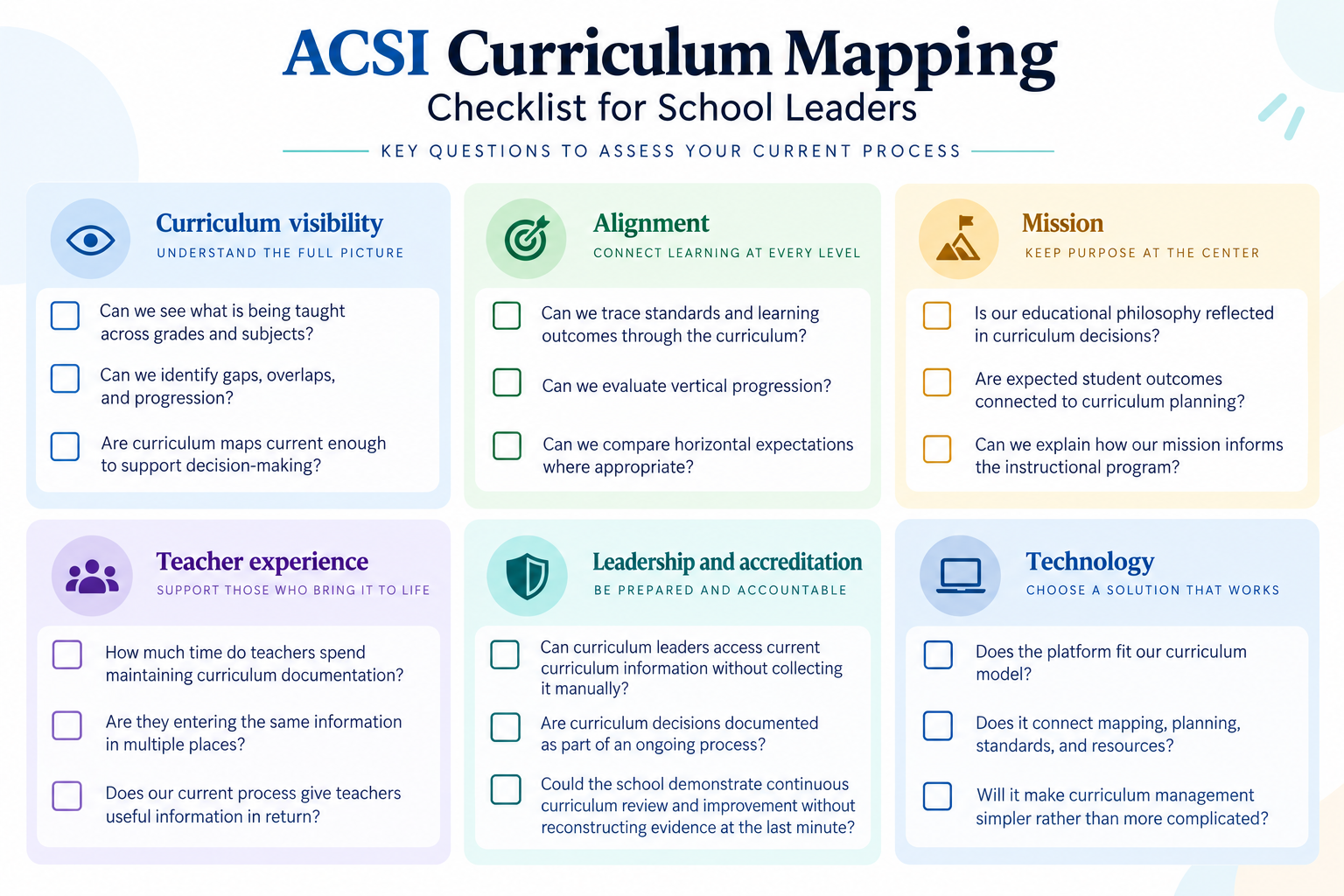
Accreditation documentation is often more useful when it is a byproduct of good curriculum management rather than a separate project undertaken every few years. For ACSI schools, maintaining current curriculum information can help create a stronger record of how the instructional program is planned, reviewed, evaluated and improved.
Instead of gathering evidence retrospectively, schools can maintain documentation as part of their normal curriculum processes. Depending on the school's model, that may include curriculum maps, standards alignment, learning objectives, assessments, course plans, curriculum revisions, resources and records of curriculum review. This approach also reduces institutional dependence on individual people.
If a curriculum director leaves, the school should not have to reconstruct years of curriculum decisions from personal files. If an experienced teacher retires, important knowledge about course progression and curriculum resources should remain accessible to the school. That is one of the less obvious benefits of modern curriculum management: it turns individual curriculum knowledge into institutional knowledge. And that supports continuous improvement well beyond an accreditation cycle.
Moving Beyond CurriculumTrak: Options for ACSI Schools
For schools that have used Curriculum Trak for years, it is time to look forward to modern curriculum management tools. With the legacy curriculum management software winding down by December 2027, existing CurriculumTrak users can consider switching to modern curriculum management tools.
In fact, a better approach is to consider what the school needs its curriculum management process to do next, i.e. improve or transition. For those schools, platforms such as Atlas, Toddle and Edusfere offer different approaches to curriculum management.
Atlas
Atlas has a long-standing focus on curriculum mapping, standards alignment and curriculum documentation. It can be a relevant option for schools looking for a structured approach to mapping and reviewing curriculum across the school.
Edusfere
Edusfere brings a distinct advantage for ACSI schools. Edusfere is ACSI's officially recommended curriculum mapping and management partner and maintains regular contact with ACSI senior leadership and its accreditation team. This close strategic relationship gives Edusfere an ongoing understanding of the curriculum, documentation, alignment and accreditation needs schools face.
Its platform connects curriculum mapping with lesson planning, standards alignment, resources and curriculum visibility. The focus goes beyond storing curriculum maps to helping schools manage curriculum as an ongoing process.
For schools moving away from CurriculumTrak, that can make migration an opportunity to do more than transfer existing data. Schools can review outdated curriculum information, strengthen alignment and build a more sustainable approach to curriculum management and accreditation readiness.
Toddle
Toddle takes a broader teaching and learning approach. Alongside curriculum planning, it brings together areas such as assessment, collaboration and classroom workflows. This can appeal to schools looking for a wider instructional platform.
Make migration a curriculum decision, not just a data exercise.
5 Ways ACSI Schools Can Modernize Curriculum Mapping Without Losing Their Mission
Modernization does not require schools to discard everything they currently do. In many cases, the better approach is to identify the points where the current process creates unnecessary work or limits visibility, and improve those first.
1. Begin With the Curriculum, Not the Platform
The first step should be to define what the school needs its curriculum process to accomplish. Leadership teams should clarify the standards, learning outcomes, curriculum structures, alignment expectations, assessment relationships and mission-related priorities they need to see and manage. Only then should they evaluate curriculum mapping software.
This order matters because every platform comes with assumptions about how the curriculum should be organized. Starting with the tool can unintentionally force the school to adapt its curriculum process to the software rather than selecting technology that supports the school's established educational model.
2. Establish a Shared Source of Curriculum Information
When curriculum information is distributed across spreadsheets, folders, documents and individual teacher files, schoolwide curriculum oversight becomes unnecessarily difficult. A centralized system gives teachers and leaders a common reference point. It can also make it easier to connect curriculum maps with standards, lesson planning, resources and assessment information.
For school leaders, the benefit is visibility. For teachers, it is access to relevant information without having to search through multiple systems. For the institution, it is continuity.
3. Make Curriculum Review Continuous Rather Than Periodic
A curriculum map is most useful when it reflects the curriculum students are actually experiencing.
Schools can build regular review into existing department meetings, professional learning communities, planning cycles, assessment reviews and leadership conversations. The review does not need to become another major administrative initiative. Instead, schools can ask focused questions at appropriate points throughout the year. Are standards still appropriately addressed? Is learning progressing as intended? Have teachers identified gaps? Are students encountering unnecessary repetition? Do assessments provide evidence of the intended learning?
Over time, those small reviews create a much more current picture of the curriculum than a once-a-year mapping exercise.
4. Reduce the Administrative Burden on Teachers
Teacher participation is essential to successful curriculum management but teachers are also the people most likely to resist a process that feels like duplicate paperwork.
A modern curriculum platform should therefore make teachers' work easier, not simply give them another place to enter information. Reusable curriculum information, centralized resources, standards connections, collaborative planning and streamlined documentation can all help reduce repetitive work.
AI can also assist with some of the administrative side of curriculum development. Used responsibly, it can help organize information, accelerate drafting and surface relationships in curriculum data. The professional judgment of teachers and curriculum leaders should remain central to decisions about learning.
5. Use Curriculum Information to Drive Improvement
The greatest value of curriculum mapping appears when schools begin using the information to make decisions. A connected curriculum system might reveal that a standard is introduced repeatedly but receives limited opportunities for mastery. It might show that several courses cover similar content while another important learning outcome receives little attention.
Those findings can lead to curriculum revision, professional learning, resource changes, or adjustments to assessment. At that point, curriculum mapping has moved beyond documentation. It has become part of the school's improvement infrastructure.
What Should ACSI Schools Look for in Curriculum Mapping Software?
Choosing curriculum mapping software should be approached as a curriculum leadership decision rather than a technology purchase. A useful platform should support the way the school already thinks about curriculum while providing enough structure to improve consistency and visibility. Several capabilities deserve particular attention.
Centralized curriculum mapping
The platform should provide a current view of curriculum across grades, subjects, and courses rather than requiring leaders to assemble that view manually.
Standards and learning objective alignment
Schools should be able to connect standards and intended learning outcomes to curriculum plans and examine where they are addressed.
Vertical and horizontal alignment
Leaders should be able to examine progression across grades and compare curriculum expectations across courses or sections.
Curriculum collaboration
Teachers should be able to contribute to and learn from shared curriculum information without losing appropriate professional autonomy.
Curriculum analytics and reporting
Data should help leaders identify patterns, gaps, overlaps, and areas requiring attention rather than simply producing more documentation.
Institutional knowledge
The platform should help the school preserve curriculum knowledge over time, particularly as teachers and leadership teams change.
Accreditation support
Schools should be able to maintain useful curriculum evidence as part of ongoing practice rather than creating a separate documentation exercise for accreditation.
Ease of use
Perhaps most importantly, the system should be practical for teachers. A platform that requires excessive data entry will eventually undermine the very curriculum process it is intended to improve.
Where Edusfere Fits Into the Modernization Conversation
For ACSI schools considering this transition, Edusfere provides an example of what a more connected curriculum management approach can look like.
Edusfere works specifically in the school curriculum management space, bringing curriculum mapping, lesson planning, standards alignment, resources and curriculum visibility into a shared environment. Its work with ACSI schools also gives it a useful understanding of the needs of schools operating within an ACSI accreditation context. That relationship is relevant because technology is most useful when it understands the environment in which educators actually work.
For a school evaluating curriculum mapping software, the question should not simply be whether a platform offers mapping, standards or reporting as individual features. The more important question is whether those capabilities work together to support the school's curriculum process. This is an area where Edusfere's broader curriculum management model is particularly relevant.
Rather than treating curriculum mapping as an isolated activity, the platform is designed to connect mapping with the work teachers and curriculum leaders already do: planning instruction, aligning standards, organizing resources and reviewing curriculum.
That connected approach supports the larger shift from maintaining curriculum documents to managing curriculum as an ongoing institutional process.
A Practical Roadmap for Modernizing Curriculum Mapping
Schools do not need to digitize their entire curriculum history before they can begin improving curriculum management. A phased approach is often more practical.
Start with an audit
Map the current curriculum workflow before changing it. Identify where curriculum information lives, who maintains it, how often it is reviewed and where teachers or leaders duplicate work. This often reveals that the first opportunity is not technology at all. It is eliminating unnecessary complexity.
Establish the alignment framework
Determine what the school needs to see across the curriculum. This may include standards, learning objectives, assessments, expected student outcomes, vertical progression, horizontal consistency and mission-related priorities. A clear framework makes technology selection much more focused.
Digitize what is current and useful
Once the framework is established, move active curriculum information into a centralized environment. Avoid simply importing every historical document. Old curriculum that has not been reviewed should not automatically become the foundation of the new system.
Build review into existing practice
The system becomes valuable when people use it to make decisions. Connect curriculum review to department planning, PLC conversations, assessment analysis, professional learning and school improvement work. Over time, the curriculum map becomes a living source of information rather than a document waiting for its next formal review.
Standard Alignment Does Not Mean Every Classroom Looks the Same
There is an important distinction that schools should make when modernizing curriculum management; alignment is not the same as standardization. A coherent curriculum can establish common expectations for essential learning while allowing teachers to determine how best to help their students achieve those outcomes.
That might mean agreeing on standards, essential learning outcomes, curriculum progression, and assessment expectations while giving teachers flexibility in instructional strategies, texts, examples and classroom activities.
In practice, clearer curriculum alignment can actually strengthen teacher autonomy. When teachers know what is essential, they have a clearer understanding of where professional choice belongs. For mission-driven schools, this balance is particularly valuable. The objective is not to make every classroom identical. It is to make the overall student experience intentional and coherent.
How Should Schools Measure Whether Curriculum Modernization Is Working?
The number of completed curriculum maps is an easy metric to track, but it tells school leaders very little about whether the process is actually improving curriculum. Better measures focus on visibility, usability and decision-making.
Schools can ask whether teachers can find current curriculum information quickly, whether leaders can see progression across grades, and whether gaps and redundancies are easier to identify. They can also look at whether curriculum review is happening more consistently, whether teachers are spending less time on duplicate documentation and whether curriculum decisions are increasingly informed by evidence.
For ACSI schools, there is an additional question, i.e. can the school clearly demonstrate how curriculum is being reviewed and improved while remaining connected to its educational philosophy and mission? That is a much more meaningful measure of modernization than software adoption alone.
Frequently Asked Questions About ACSI Curriculum Mapping
What is ACSI curriculum mapping?
ACSI curriculum mapping is the process of documenting and reviewing curriculum across grades and subjects while considering standards, learning outcomes, assessment, curriculum progression, and the school's educational philosophy and mission. It helps schools understand not only what is taught, but how learning develops and how the instructional program supports the school's broader educational goals.
Does ACSI require schools to use curriculum mapping software?
ACSI does not require schools to use a particular curriculum mapping software platform. The important consideration is whether the school's curriculum processes effectively support intentional planning, alignment, documentation, evaluation, and continuous improvement within its educational context.
How does curriculum mapping support ACSI accreditation?
Curriculum mapping can help schools maintain evidence of curriculum planning, alignment, implementation, review, and improvement. A centralized curriculum management system can make that evidence easier to maintain and access because documentation becomes part of normal curriculum operations rather than a separate accreditation project.
What is the difference between curriculum mapping and curriculum management?
Curriculum mapping focuses on documenting and visualizing what is taught and how learning progresses. Curriculum management encompasses the broader processes used to plan, align, implement, review, document, and improve curriculum. Curriculum mapping is therefore one important component of a larger curriculum management strategy.
How does curriculum mapping improve vertical alignment?
Vertical curriculum alignment helps schools examine how knowledge and skills develop from one grade or course to another. It can reveal gaps, unnecessary repetition, and places where students are expected to demonstrate learning before the necessary foundation has been established.
How does curriculum mapping support horizontal alignment?
Horizontal alignment allows schools to compare curriculum expectations across courses, subjects, classrooms or sections at the same level. It can improve consistency around essential learning while allowing teachers flexibility in instructional methods.
Can curriculum mapping support a school's mission?
Yes, when mission alignment is treated as part of curriculum leadership rather than as a separate documentation requirement. A curriculum management system can help leaders organize and review the information needed to understand how the instructional program connects with the school's educational philosophy and intended outcomes.
Can AI be used in curriculum mapping?
AI can support tasks such as organizing curriculum information, accelerating documentation, identifying relationships and reducing repetitive administrative work. However, decisions about curriculum quality, instructional priorities, student learning and mission alignment should remain with educators and school leaders.
The best curriculum mapping platform is not necessarily the one with the longest feature list. It is the one that helps a school maintain a clear line between what students learn, how that learning develops, why it matters and how the school continually improves the experience.
The Goal Is a Stronger Curriculum, Not a More Digital One
The modernization of curriculum mapping presents ACSI schools with an opportunity to solve a problem that has existed for years; the difficulty of maintaining a clear, current picture of the curriculum across an entire school.
Technology can help connect information that has traditionally been scattered across spreadsheets, documents, planning tools and individual teacher files. It can make vertical and horizontal alignment easier to examine, reduce repetitive documentation, preserve institutional knowledge and support more continuous curriculum review. But none of those capabilities replaces curriculum leadership.
The school's mission should still determine what matters. Educators should still determine what students need to learn and how best to teach it. Leaders should still make the decisions about curriculum quality, coherence and improvement. The role of technology is to make those decisions easier to inform and easier to sustain.
For ACSI schools, that is the more meaningful definition of modernization. It is not about creating a curriculum that is more digital. It is about creating a curriculum that is more visible, more coherent, easier to improve and more consistently connected to the purpose of the school.
And when curriculum mapping becomes part of that ongoing process, not simply another document to maintain, the technology is doing what it should, i.e., supporting the mission rather than competing with it.