
Inside This Blog
- Why lesson plans, unit plans and curriculum maps are often confused
- The role each planning layer plays in curriculum design and instructional delivery
- How the three work together to create a coherent instructional framework
- A practical comparison of lesson plans, unit plans, and curriculum maps
- Common curriculum planning challenges schools face
- Why connected curriculum management is becoming a strategic priority for K-12 schools
Curriculum planning rarely breaks down because schools lack planning documents. Most schools have lesson plans. Many have thoughtfully designed unit plans. Some have curriculum maps that outline standards and pacing across the academic year. The challenge is that these planning layers often exist in isolation.
Lesson plans live in individual teacher folders. Unit plans are stored in shared drives. Curriculum maps sit in spreadsheets or legacy curriculum management systems. As a result, school leaders struggle to answer fundamental questions:
- Are we teaching the intended curriculum consistently across classrooms?
- Where are standards introduced, reinforced and mastered?
- Are students encountering unnecessary repetition or critical learning gaps?
- How easily can we adapt curriculum when standards or instructional priorities change?
These aren't simply administrative concerns. They directly influence instructional quality, teacher collaboration, curriculum reviews, accreditation readiness and student learning outcomes.
Understanding the relationship between lesson plans, unit plans and curriculum maps is therefore essential for every K-12 school. While these terms are sometimes used interchangeably, they serve distinct purposes and operate at different levels of curriculum planning. Together, they create the instructional framework that ensures daily teaching aligns with broader educational goals.
This guide explains how each planning layer contributes to effective curriculum management, where schools commonly experience disconnects.
Curriculum Planning Happens at Three Different Levels
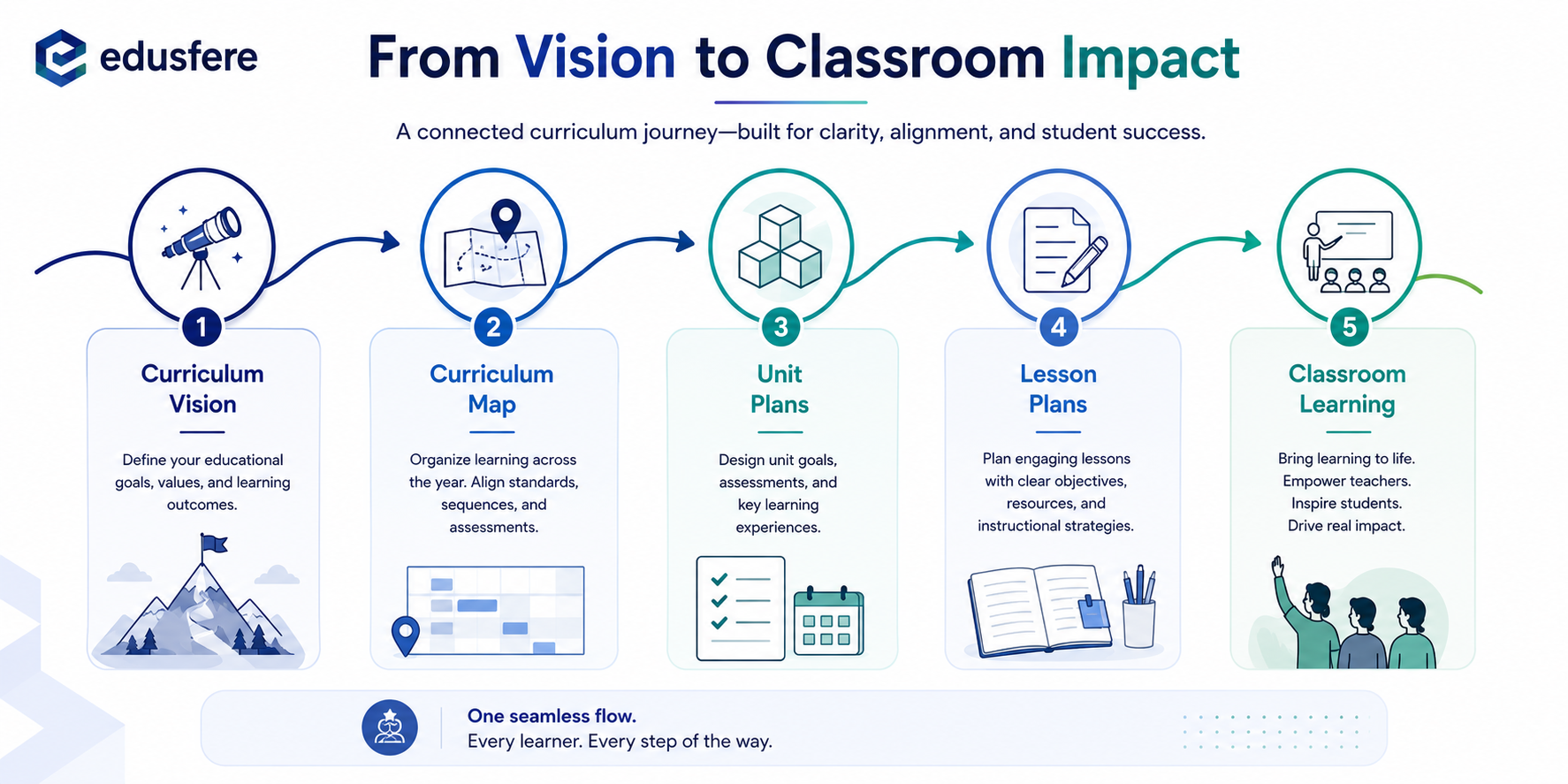
One of the most common misconceptions in education is that lesson plans, unit plans and curriculum maps represent different ways of documenting the same thing. They don't. Instead, they represent three interconnected levels of curriculum planning, each serving a different audience, answering different questions and supporting different decisions.
Think of curriculum planning as a hierarchy rather than a collection of independent documents. At the highest level, school leaders define what students should learn and how learning should progress across grades and subjects. This is the role of the curriculum map.
The curriculum is then organized into meaningful instructional sequences through unit plans, which determine how broader learning goals are translated into teachable units. Finally, teachers bring those units to life through lesson plans that guide daily classroom instruction.
Each planning layer builds upon the one above it. Without curriculum maps, schools lack visibility into the broader curriculum. Without unit plans, instruction can become fragmented and inconsistent. Without lesson plans, even the strongest curriculum cannot be effectively delivered in the classroom. The most effective schools don't choose one planning approach over another. They ensure all three work together.
Lesson Plans: Turning Curriculum into Daily Learning
A lesson plan is the most detailed level of instructional planning. It focuses on a single lesson or class session and provides teachers with a roadmap for delivering instruction, engaging students and assessing learning. While lesson plan formats vary between schools, most include:
- Learning objectives
- Teaching and learning activities
- Classroom resources
- Assessment strategies
- Differentiation and accommodations
- Success criteria
- Homework or extension activities
Lesson plans answer practical classroom questions such as:
- What will students learn today?
- How will they engage with the content?
- How will understanding be assessed?
- What adjustments may be needed for different learners?
Because lesson plans respond to the realities of classroom teaching, they are often the most flexible planning documents. Teachers continuously refine them based on student progress, formative assessment and classroom dynamics. However, lesson plans are intentionally narrow in scope. They focus on today's learning rather than the broader instructional journey. Viewed independently, they provide limited insight into how learning develops across weeks, semesters or grade levels.
Unit Plans: Connecting Individual Lessons into Meaningful Learning
If lesson plans define the daily learning experience, unit plans provide the instructional structure that connects those lessons into a coherent sequence. Rather than focusing on a single class period, a unit plan organizes several weeks of instruction around a central concept, inquiry, theme or set of learning outcomes.
A well-designed unit plan typically outlines:
- Essential questions
- Big ideas and enduring understandings
- Curriculum standards
- Learning objectives
- Sequence of lessons
- Major formative and summative assessments
- Projects and performance tasks
- Required instructional resources
Instead of asking, "What will students learn today?", unit plans answer a broader question:
"How will students develop mastery of this topic over time?"
For example, a middle school science unit on ecosystems may include lessons on food chains, biodiversity, environmental change and conservation before culminating in an inquiry-based project. Each lesson has its own objectives and activities. But collectively, they contribute toward the larger learning goals established by the unit.
This structured progression helps ensure instruction is intentional rather than episodic. Concepts build upon one another, assessments measure cumulative understanding and teachers maintain a clear sense of where students are within the learning journey.
For collaborative teaching teams, unit plans also create consistency across classrooms while still allowing individual teachers flexibility in how they deliver daily instruction.
Curriculum Maps: Creating a School-Wide View of Learning
While lesson plans and unit plans primarily support classroom instruction, curriculum maps serve a broader strategic purpose. A curriculum map provides a comprehensive view of what is taught, when it is taught and how learning progresses across courses, grade levels, departments or an entire school.
Rather than documenting instructional activities, curriculum maps reveal the structure of the curriculum itself. They help school leaders answer questions such as:
- Are curriculum standards fully addressed?
- Is learning appropriately sequenced across grade levels?
- Where are concepts unnecessarily repeated?
- Which learning outcomes receive insufficient attention?
- How well are assessments aligned with curriculum expectations?
- Are departments teaching consistently across multiple classes or campuses?
Depending on the school's curriculum model, a curriculum map may include:
- Units of study
- Standards alignment
- Learning outcomes
- Assessment milestones
- Instructional timeframes
- Cross-curricular connections
- Vertical progression across grades
- Horizontal alignment across classrooms
Unlike lesson plans, curriculum maps are not intended to prescribe daily instruction. Instead, they provide visibility. They enable curriculum directors, principals, department heads and instructional leaders to evaluate curriculum as a connected system rather than a collection of isolated classroom documents. This strategic perspective becomes increasingly important as schools grow, adopt new standards, prepare for accreditation or seek greater consistency across teaching teams.
Without curriculum maps, leadership often relies on anecdotal evidence or manual document reviews to understand what is actually being taught. Curriculum mapping replaces guesswork with transparency, making curriculum review, instructional improvement and long-term planning significantly more manageable.
Lesson Plans vs. Unit Plans vs. Curriculum Maps: A Practical Comparison
Although lesson plans, unit plans, and curriculum maps are closely related, they operate at different levels of instructional planning. Understanding these distinctions helps schools clarify ownership, improve collaboration and ensure every planning decision supports the broader curriculum.
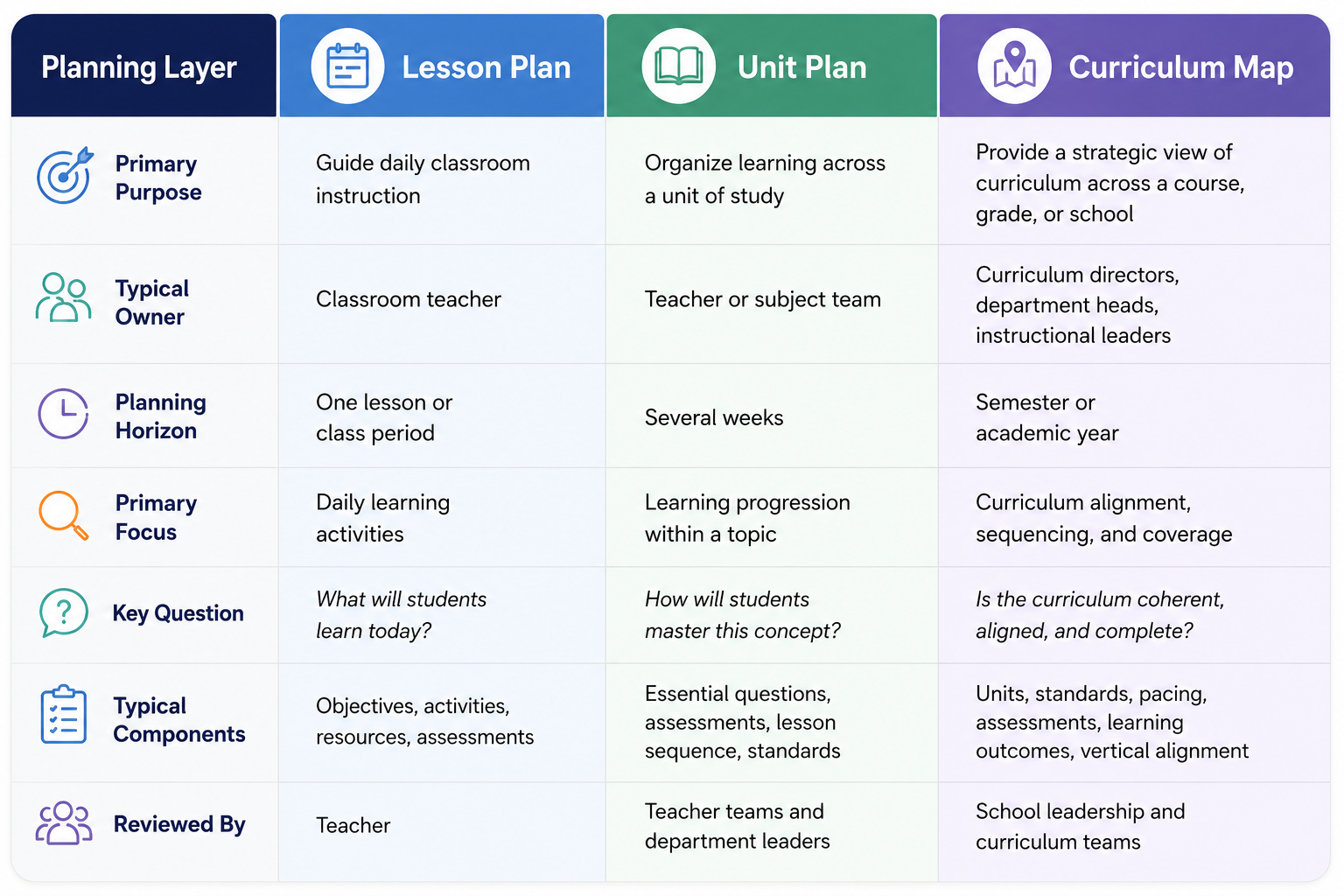
Rather than replacing one another, these planning tools create a connected framework. Each level provides context for the next, ensuring that classroom instruction remains aligned with the school's long-term educational goals.
How Lesson Plans, Unit Plans and Curriculum Maps Work Together
The relationship between these planning layers is best understood as a continuous flow rather than three separate documents. It begins with the curriculum.
School leaders establish what students should learn over the course of a year, how learning should progress between grades and which standards must be addressed. These decisions form the curriculum map.
The curriculum map is then translated into unit plans that organize broader learning goals into manageable instructional sequences. Units determine the order in which concepts are introduced, practiced, assessed and revisited.
Finally, teachers develop lesson plans that bring each unit to life through daily instruction, classroom discussions, learning activities, formative assessments and differentiated teaching strategies.
The process can be visualized as follows:
Curriculum Vision → Curriculum Map → Unit Plans → Lesson Plans → Classroom Learning
Each layer informs the next. When these planning layers remain connected, schools gain confidence that what happens in individual classrooms reflects the broader curriculum rather than isolated teaching decisions. Just as importantly, information can flow in the opposite direction.
Assessment results, teacher feedback and classroom experiences can inform future revisions to unit plans and curriculum maps, allowing schools to continuously refine their curriculum instead of treating it as a static document. This cyclical approach is one of the defining characteristics of high-performing school systems.
Common Curriculum Planning Challenges Schools Face
While every school approaches curriculum differently, several planning challenges appear consistently across K-12 education.
Lesson Plans Become Isolated
In many schools, lesson plans are stored within individual teacher accounts or personal files. Although this gives teachers flexibility, it also limits collaboration and makes instructional knowledge difficult to preserve over time. When teachers leave, valuable instructional resources often leave with them.
Unit Plans Drift Over Time
Unit plans are intended to provide consistency across classrooms but they frequently evolve independently as teachers make local adjustments. Without a shared review process, different sections of the same course may gradually diverge, resulting in inconsistent learning experiences for students.
Curriculum Maps Become Static Documents
Many curriculum maps are created during curriculum reviews but receive little attention afterward. As instructional practices evolve and standards change, these documents quickly become outdated. When curriculum maps no longer reflect classroom practice, they lose much of their value as leadership tools.
Standards Alignment Becomes Difficult to Track
Whether schools follow state standards or another curriculum, maintaining accurate standards alignment across multiple grades and subjects is challenging. Manual processes make it difficult to identify where standards are introduced, reinforced, assessed and ultimately mastered.
Curriculum Reviews Become Time-Consuming
Preparing for accreditation or internal curriculum reviews often requires collecting documents from multiple teachers, reconciling different versions and manually verifying curriculum alignment. What should be an ongoing process becomes an intensive administrative exercise.
Why Connected Curriculum Management Matters
Curriculum management has evolved significantly over the past decade. Schools are no longer looking for software that simply stores curriculum documents. They need systems that improve visibility, strengthen collaboration and make curriculum easier to maintain as educational priorities evolve. This shift reflects a broader change in how schools view curriculum itself.
Rather than treating curriculum as a collection of independent documents, leading schools increasingly manage it as a connected instructional ecosystem. Within this ecosystem:
- Curriculum maps define the overall learning journey.
- Unit plans translate that journey into coherent instructional sequences.
- Lesson plans support effective classroom delivery.
- Standards, assessments and learning outcomes remain connected throughout the process.
When these planning layers are managed together, schools gain several strategic advantages. Teachers can collaborate more effectively without sacrificing instructional autonomy. Curriculum leaders can monitor alignment across departments and grade levels. Standards updates can be implemented consistently without manually revising hundreds of disconnected documents. Leadership teams gain real-time visibility into curriculum implementation rather than relying on periodic audits or spreadsheet reviews.
Perhaps most importantly, the curriculum becomes a living framework that evolves continuously through collaboration and evidence, rather than remaining a static document revisited every few years. For schools committed to continuous improvement, connected curriculum management is increasingly becoming the foundation for instructional quality, consistency and long-term sustainability
Lesson plans, unit plans and curriculum maps are often discussed as though they are separate planning tools. In reality, they represent different perspectives on the same curriculum. Lesson plans focus on daily instruction. Unit plans organize learning across meaningful sequences.
Curriculum maps provide the strategic view that ensures teaching remains aligned across classrooms, grade levels and the entire school. When any one of these planning layers operates independently, schools lose visibility into how learning connects over time. When they work together, curriculum becomes more coherent, collaboration becomes easier and instructional decisions become better informed.
As expectations around curriculum quality, accountability and continuous improvement continue to grow, schools need more than well-written planning documents. They need a connected curriculum that supports both classroom practice and strategic leadership.
Frequently Asked Questions
What is the difference between a lesson plan, a unit plan and a curriculum map?
A lesson plan guides daily classroom instruction. A unit plan organizes multiple lessons around a shared learning goal, while a curriculum map provides a school-wide view of curriculum sequencing, standards alignment and learning progression across an academic year.
Which comes first: the curriculum map or the lesson plan?
Curriculum planning typically begins with the curriculum map, which establishes the overall scope and sequence. Unit plans are then developed to organize instruction within that framework, followed by lesson plans that guide day-to-day teaching.
Can schools have effective lesson plans without a curriculum map?
Teachers can certainly develop strong lesson plans without a formal curriculum map. However, without a curriculum map, schools often struggle to ensure consistency, avoid duplication, identify learning gaps and maintain alignment across grades and departments.
Who is responsible for creating curriculum maps?
Curriculum maps are generally developed collaboratively by curriculum directors, instructional leaders, department heads and teacher teams. Classroom teachers play an important role by providing feedback that keeps curriculum maps aligned with classroom practice.
Why are curriculum maps important for school leaders?
Curriculum maps give school leaders visibility into what is being taught, when it is taught, and how learning progresses across the school. This supports curriculum reviews, accreditation, standards alignment, instructional consistency and continuous improvement.
How does curriculum management software improve curriculum planning?
Modern curriculum management software connects curriculum maps, unit plans, lesson plans, standards, assessments and instructional resources within one collaborative platform. This reduces administrative complexity, improves curriculum visibility and makes it easier for schools to maintain alignment as curricula evolve.
Bring Your Curriculum Together with Edusfere
Many schools still manage lesson plans, unit plans, curriculum maps and standards across multiple spreadsheets, shared drives and disconnected systems. While these tools may support individual planning tasks, they often make collaboration, curriculum reviews and school-wide visibility unnecessarily complex.
Edusfere is a modern curriculum management platform designed to connect every layer of curriculum planning in one place. From curriculum maps and unit plans to standards alignment, assessments and instructional resources, Edusfere helps schools build a living curriculum that is collaborative, transparent and easy to maintain.
Whether you're strengthening vertical alignment, preparing for accreditation or simply looking to reduce administrative complexity, Edusfere provides school leaders with the visibility and flexibility needed to continuously improve curriculum across every grade and subject.
Ready to modernize your curriculum management?
Explore how Edusfere helps K-12 schools create connected, future-ready curricula through one collaborative platform.