

Accreditation reviews often bring a familiar question to the forefront for school leaders, i.e. can we clearly demonstrate that learning is happening and improving across our classrooms? In 2026, accreditation bodies expect schools to move beyond anecdotal evidence and show structured proof of student learning. This means demonstrating how lesson planning, formative assessments and summative assessments work together to measure progress and guide instruction.
The emphasis on evidence is not accidental. A latest research examining 13 meta-analyses of formative assessment in K-12 education found consistent positive effects on student learning outcomes, with impacts ranging from small to substantial depending on how assessments are implemented.
For schools, assessments are not just evaluation tools, they are evidence systems. When formative assessments and summative assessments are integrated into lesson planning and supported through curriculum mapping and curriculum management, they create a clear record of learning progression. That record becomes critical during accreditation reviews, curriculum audits and institutional evaluations.
Formative Assessments: Documenting Learning in Progress
Formative assessments are often described as “checks for understanding,” but in the context of accreditation and curriculum management, they serve a larger purpose. They provide continuous evidence that teaching strategies are guiding students toward defined learning outcomes.
Evidence strongly supports their impact. A large synthesis of research by educational scholars Paul Black and Dylan Wiliam found that formative assessment practices can produce learning gains equivalent to roughly 6-8 months of additional progress in a school year when feedback is used effectively.
When incorporated into lesson planning, formative assessments help schools demonstrate that learning progress is monitored systematically rather than evaluated only at the end of instruction.
Key roles of formative assessments include:
Tracking student progress during instruction: Formative assessments provide real-time insight into how students are grasping concepts. This allows teachers to adjust instruction and provides documented evidence that learning is actively monitored.
Identifying learning gaps early: Early detection of misunderstandings helps schools demonstrate proactive intervention strategies, an important criterion in many accreditation reviews.
Supporting reflective teaching practices: Formative evidence shows how teachers refine instruction based on student needs, reinforcing the school’s commitment to continuous improvement.
When captured within curriculum mapping systems, formative assessments also contribute to a broader institutional evidence base rather than remaining isolated in individual classrooms.
Summative Assessments: Demonstrating Learning Outcomes
While formative assessments monitor learning during instruction, summative assessments confirm whether students have achieved the intended learning outcomes. Accreditation reviews rely heavily on summative evidence because it provides measurable indicators of student achievement. However, summative assessments alone rarely tell the full story. Their value increases when they are clearly connected to formative data and lesson planning decisions.
Effective Summative Assessment systems typically demonstrate:
Clear alignment with curriculum standards: Summative tasks should directly measure the learning objectives outlined in the curriculum, ensuring that evaluation reflects what students were actually taught.
Consistency across classrooms and subjects: Accreditation bodies look for evidence that assessment standards are applied uniformly across the school.
Evidence of mastery and progression: Summative results should show not only performance at a moment in time but also improvement across academic terms or grade levels.
Through curriculum mapping and curriculum management frameworks, schools can trace how formative assessments prepare students for summative evaluation, creating a coherent narrative of learning progression.
Connecting Lesson Planning with Assessment Evidence
Lesson planning is often where alignment begins. Well-designed lesson plans integrate formative assessments throughout the learning sequence while preparing students for summative expectations. When lesson planning and assessment design operate independently, evidence becomes fragmented. Teachers may assess learning effectively but schools struggle to demonstrate how those assessments connect to curriculum outcomes.
A structured approach to lesson planning ensures that:
Learning objectives drive assessment design: Teachers plan formative and summative assessments around clearly defined outcomes, ensuring alignment with curriculum standards.
Instruction builds toward measurable outcomes: Each lesson contributes to the progression toward summative assessment goals.
Evidence collection becomes systematic: Schools can document how learning was monitored and evaluated across the instructional cycle.
Curriculum mapping software such as Edusfere helps schools integrate lesson planning with assessment design, making these connections visible and accessible during accreditation reviews.
Curriculum Mapping: Turning Assessments into Accreditation Evidence
Many schools already conduct assessments effectively, but accreditation reviews require something more: documentation. Curriculum mapping plays a crucial role in transforming classroom evidence into institutional evidence.
By linking standards, lesson planning and assessments in one structured framework, curriculum mapping enables schools to demonstrate alignment across the learning process.
Some of its key benefits include:
Visibility across grades and subjects: Curriculum mapping reveals how learning outcomes progress from one grade level to the next, providing accreditation teams with a clear view of curriculum coherence.
Traceability of assessments to standards: Schools can demonstrate that both formative assessments and summative assessments directly measure intended learning objectives.
Documentation of instructional decisions: Mapping records how lesson planning, assessments and curriculum adjustments interact, offering strong evidence of curriculum management.
Modern AI-powered Edtech platforms like Edusfere simplify this process by enabling schools to maintain living curriculum maps that evolve alongside instructional practice.
Curriculum Management: Making Evidence Actionable
Collecting assessment evidence is only part of the accreditation process. Review committees also examine whether schools use this evidence to inform decisions.
This is where curriculum management becomes critical. Schools must demonstrate that assessment data leads to meaningful action such as instructional adjustments, curriculum revisions or targeted interventions.
Strong curriculum management typically involves:
Regular curriculum review cycles: Schools periodically evaluate formative and summative assessment results to identify patterns and areas for improvement.
Collaborative decision-making among educators: Teachers and academic leaders discuss assessment evidence to refine lesson planning and instructional strategies.
Data-informed curriculum updates: Curriculum maps evolve based on evidence, ensuring that teaching practices remain aligned with learning outcomes.
Edusfere’s curriculum mapping software supports this process by centralizing assessment data and curriculum information, enabling schools to make informed decisions during accreditation cycles.
Preparing for Accreditation Reviews with Assessment Systems
When schools prepare for accreditation visits, leaders often discover that the evidence already exists but it is simply scattered across lesson plans, assessment records and classroom documentation.
A structured assessment system helps schools consolidate this information and present it clearly to reviewers. Schools that succeed in accreditation reviews typically demonstrate:
Alignment between curriculum standards and assessments.
Continuous monitoring of student learning through formative assessments.
Reliable summative assessment outcomes.
Consistent results across subjects and grade levels reinforce the credibility of the school’s instructional model.
By integrating lesson planning, curriculum mapping, and assessment design, schools can build a robust evidence framework long before accreditation reviews begin.
A Practical Assessment Evidence Framework for Accreditation Reviews
Before accreditation visits, schools should ensure that their assessment systems clearly document how student learning is monitored and evaluated. A structured evidence framework helps leadership teams organize this information effectively.
Schools preparing for accreditation typically focus on three types of assessment evidence:
Evidence of learning progress through formative assessments: Documentation should show how teachers use formative assessments during lesson planning to monitor student understanding and adjust instruction.
Evidence of learning outcomes through summative assessments: Schools should demonstrate that summative assessments measure the curriculum standards and learning objectives defined in the program.
Evidence of curriculum alignment through curriculum mapping: Curriculum maps should show how lesson planning, assessments and standards are connected across grades and subjects.
When these elements are organized within a curriculum management system, schools can clearly demonstrate that assessment practices support measurable learning outcomes.
Accreditation Readiness Checklist for School Leaders
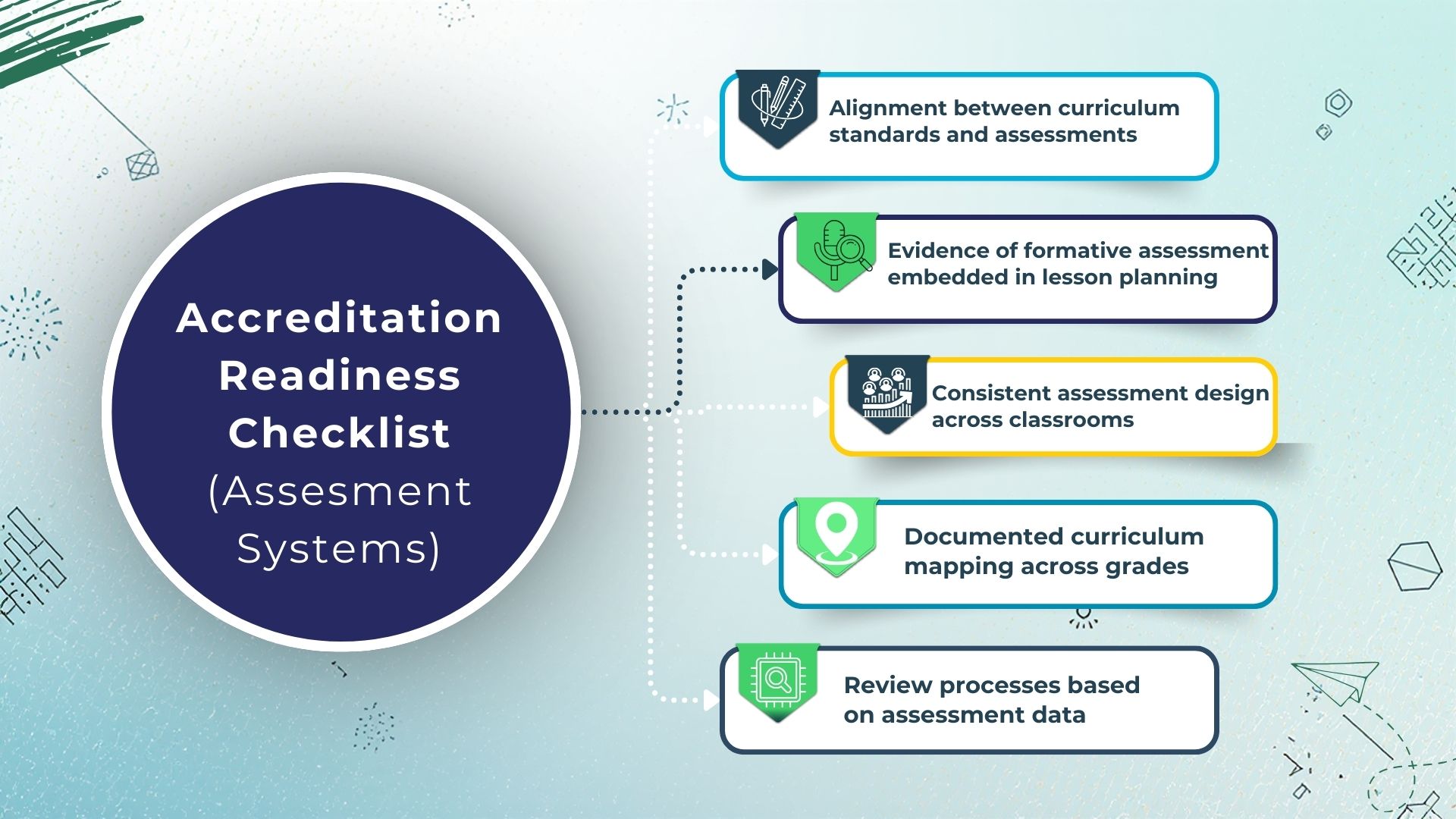
Before an accreditation review, school leaders should ensure that their assessment systems demonstrate the following:
Alignment between curriculum standards and assessments: Reviewers should be able to see how formative assessments and summative assessments measure the intended learning outcomes.
Evidence of formative assessment embedded in lesson planning: Lesson plans should clearly indicate how teachers monitor understanding during instruction.
Consistent summative assessment design across classrooms: Schools should ensure that evaluation standards are applied uniformly.
Documented curriculum mapping across grades and subjects: Curriculum maps should demonstrate progression of learning outcomes.
Curriculum review processes based on assessment data: Accreditation teams often look for evidence that assessment results inform curriculum updates.
The Role of Curriculum Mapping Software in Accreditation Readiness
Technology increasingly plays a role in helping schools organize and present assessment evidence effectively. Curriculum mapping software ensures that curriculum documentation, lesson planning and assessments remain connected.
Edusfere, an industry-leading curriculum mapping software designed for K-12 schools, supports accreditation readiness by enabling schools to:
Maintain structured curriculum maps that connect standards, lesson planning and assessments.
Track formative assessments and summative assessments across classrooms and grade levels.
Provide clear documentation for accreditation teams reviewing instructional alignment.
When curriculum information and assessment data exist within a single system, schools can present evidence with confidence and clarity.
Frequently Asked Questions (FAQs) about Assessments, Accreditation and Curriculum Alignment
Why are formative assessments important for accreditation reviews?
Formative assessments provide continuous evidence that student learning is being monitored and supported during instruction. Accreditation bodies look for proof that schools are not only evaluating outcomes but also actively guiding learning progress. When formative assessments are integrated into lesson planning and curriculum mapping, they demonstrate that teachers are using real-time feedback to improve student understanding and instructional strategies.
How do summative assessments support accreditation evidence?
Summative assessments confirm whether students have achieved the intended learning outcomes. For accreditation reviews, they provide measurable indicators of academic achievement across subjects and grade levels. When aligned with curriculum standards and supported by formative assessments, summative results help schools demonstrate both mastery and learning progression.
How does curriculum mapping strengthen assessment evidence?
Curriculum mapping connects standards, lesson planning, formative assessments and summative assessments within a structured framework. This allows schools to clearly demonstrate how instructional activities lead to measurable learning outcomes. During accreditation reviews, mapped curricula provide reviewers with visible proof that teaching, assessment and learning goals are aligned.
What role does curriculum management play in accreditation readiness?
Curriculum management ensures that assessment evidence leads to meaningful academic decisions. Schools that regularly review formative and summative data can show accreditation teams that learning outcomes are monitored and used to refine teaching strategies, adjust lesson planning and improve curriculum design.
Can curriculum mapping software help schools prepare for accreditation reviews?
Yes. Curriculum mapping software simplifies the process of documenting and organizing curriculum alignment. Platforms such as Edusfere allow schools to connect lesson planning, formative assessments, and summative evaluations within a single system. This makes it easier to present structured evidence of curriculum alignment and student learning during accreditation visits.
How can schools ensure lesson planning aligns with assessment expectations?
Effective lesson planning begins with clear learning objectives and integrates formative assessments throughout the learning process. When lesson plans are aligned with curriculum standards and summative expectations, they create a coherent instructional pathway. Curriculum mapping tools can help teachers maintain this alignment consistently across classrooms and grade levels.
How often should schools review assessment evidence for accreditation readiness?
Schools benefit from reviewing assessment data regularly rather than waiting for accreditation cycles. Many institutions conduct quarterly or semester-based curriculum reviews where formative and summative assessment results inform curriculum adjustments. This ongoing approach ensures that accreditation evidence reflects continuous improvement rather than last-minute preparation.
Strengthen Accreditation Readiness with Edusfere
Preparing for accreditation should not require scrambling for documentation or piecing together scattered evidence. Schools need systems that align lesson planning, formative assessments, summative assessments and curriculum mapping from the start.
Edusfere helps K-12 institutions build that system. As a comprehensive curriculum mapping software, it enables schools to connect assessment practices with curriculum management and maintain a clear record of learning outcomes across the organization.
With Edusfere, schools can move beyond compliance and build a culture where assessment evidence supports better teaching, stronger learning and confident accreditation reviews.
If your school is preparing for accreditation or simply looking to strengthen curriculum alignment, Edusfere provides the structure and visibility needed to turn everyday assessment practices into meaningful institutional evidence.