

Key Takeaways for K-12 School Leaders
- They include multiple federal programs with different purposes, requirements and eligible uses.
- Title I, Part A focuses on improving educational opportunities and outcomes for students from low-income families.
- Title II, Part A supports teacher and school leader effectiveness, including professional learning, recruitment, retention and leadership development.
- Title III, Part A supports English learners in acquiring English proficiency and meeting challenging academic standards. It also provides support for eligible immigrant students.
- Title IV, Part A supports three broad areas: well-rounded education, safe and healthy students and effective use of technology.
- Schools should identify the student, instructional or educator need before deciding how to spend funds.
- Professional learning, curriculum planning, instructional resources, intervention and technology should work together rather than operate as isolated initiatives.
- Federal funds generally cannot be used simply to replace state and local resources that would otherwise have been provided.
- Schools need to demonstrate the relationship between the identified need, funded activity, implementation and intended outcomes.
- A clear curriculum management process helps schools connect funded initiatives to standards, curriculum maps, unit plans, instruction and evidence of learning.
Federal education funding can play an important role in helping K-12 schools address academic needs, strengthen instruction, develop educators and expand opportunities for students. However, for many school leaders, understanding Title Funds is not straightforward. The term refers to several federal education programs, each with its own purpose, eligibility requirements, allowable activities and compliance expectations.
For principals, curriculum directors, district administrators and school improvement teams, the challenge is therefore not simply knowing what Title I, Title II, Title III or Title IV funds are. The more important question is how to use these resources strategically.
A strong funding strategy begins with the needs of students and teachers. It then connects those needs to school improvement priorities, curriculum and instruction, professional learning, and measurable outcomes. This approach helps schools avoid treating federal funding as an annual exercise in spending available dollars.
Instead, Title Funds can become part of a larger strategy for improving teaching and learning.
What Are Title Funds in K-12 Education?
The term Title Funds generally refers to federal education programs authorized under the Elementary and Secondary Education Act of 1965 or ESEA. The ESEA was most recently reauthorized through the Every Student Succeeds Act, commonly known as ESSA. These programs provide federal resources to states, school districts and schools for specific educational purposes. The U.S. Department of Education administers many of these programs, while state educational agencies and local educational agencies (LEAs) play important roles in distributing, administering and overseeing funds.
For school leaders, the important distinction is that each Title has a defined purpose. Funds cannot simply be moved from one educational need to another based on convenience.
The four programs most commonly discussed in K-12 school planning are:
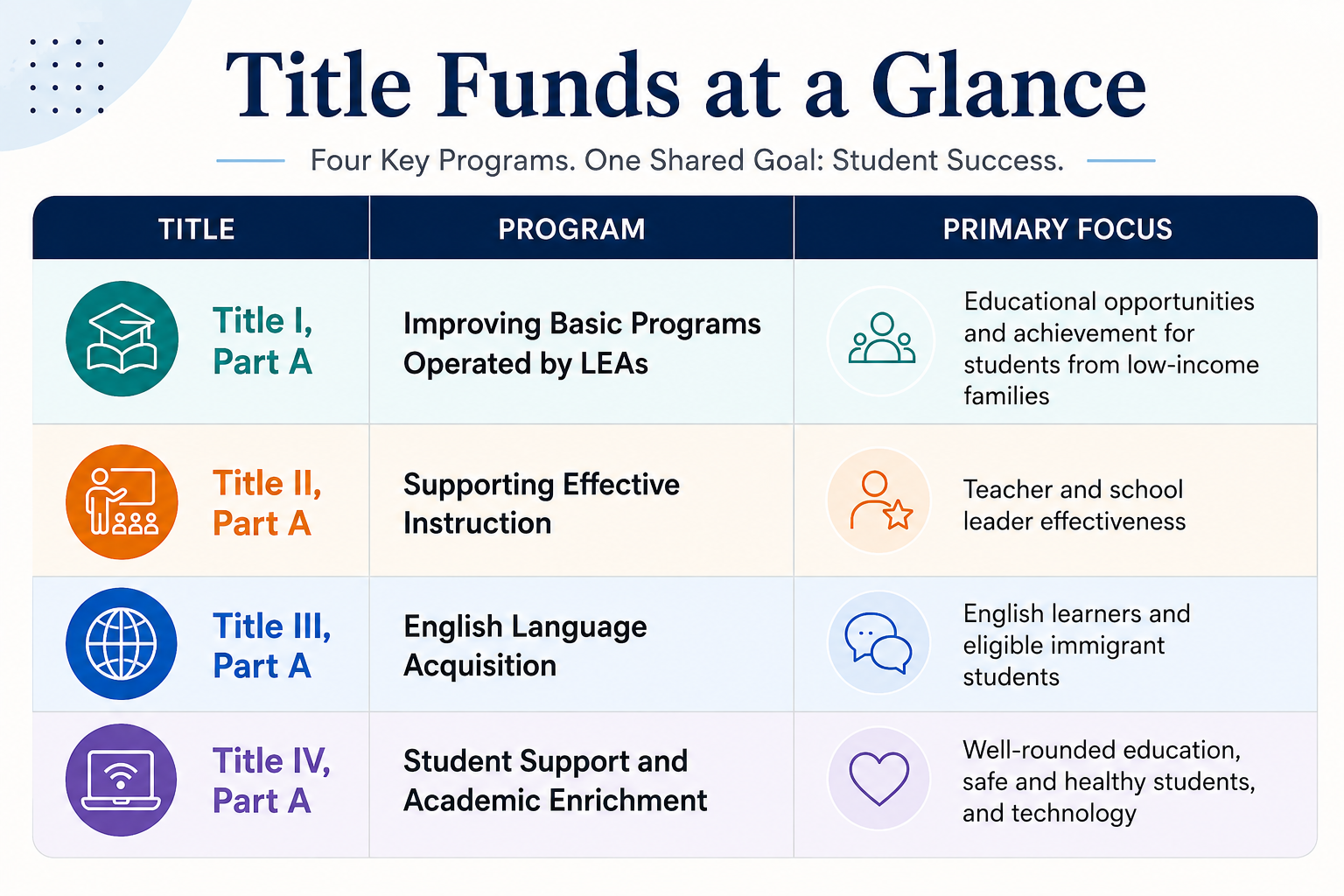
Understanding these distinctions is the foundation for responsible Title Fund management..
How Do Title Funds Work?
Before discussing individual programs, it helps to understand how federal education funding reaches schools. Title Funds generally flow from the federal government to state educational agencies and, depending on the program, to local educational agencies. School districts then determine how funds will be used within federal requirements, state guidance, local policies and approved plans. This means a principal or curriculum director may not directly control a federal allocation even when the school is the intended beneficiary of a funded initiative.
The district may control the budget. The state may establish additional requirements. The federal program may impose specific eligibility and spending rules. As a result, school leaders should understand both the educational purpose and administrative structure behind the funding.
A practical funding conversation should therefore include four questions:
- What need has the school identified?
- Which federal program is aligned with that need?
- What activities are allowable under that program?
- What district and state requirements apply to the expenditure?
This prevents schools from starting with a product or program and working backward to find a funding source.
(Important note: While Title Funds are authorized under federal law, their administration can vary by state. State educational agencies establish state-level processes, guidance, application requirements, monitoring practices and other administrative procedures for federal programs. Local educational agencies may also have additional policies and approval requirements. The examples below illustrate differences in state administration and should not be treated as a complete guide to a state's current requirements. School leaders should always verify current requirements with their state educational agency and district or LEA before planning or charging an expenditure to Title Funds.)
How Title Fund Administration Can Differ by State
Although Title Funds are grounded in federal law, school leaders should not assume that the process for accessing, planning, documenting or monitoring these funds is identical across the country. States have their own education agencies, systems, guidance, application processes, monitoring structures and administrative requirements. Local educational agencies may also establish additional procedures for approving expenditures and managing federal grants.
For principals, curriculum directors and school administrators, this means that understanding the federal purpose of a Title program is only the first step. The next step is understanding how that program is administered in the state and district where the school operates. The differences become clearer when looking at individual states.
Florida: Centralized Federal Program Guidance and LEA Support
In Florida, the Florida Department of Education (FDOE) maintains a dedicated Bureau of Federal Educational Programs that provides technical assistance, program support and monitoring to local educational agencies. Its current federal programs portfolio includes Title I, Part A; Title II, Part A; Title IV, Part A; and several other federal programs.
Florida also maintains specific resources for equitable services, including guidance and processes for eligible private schools participating in applicable ESEA programs.
For school leaders, this illustrates an important point. That is, knowing that an activity falls within the broad purpose of a federal program does not necessarily answer how the expenditure should be planned or administered locally. Florida's federal program resources also provide state-specific information on areas such as program applications, monitoring and implementation.
Practical implication for Florida schools:
A principal or curriculum director should work with the district's federal programs and finance teams. It should consult current FDOE guidance before assuming that a particular Title-funded initiative, resource or technology purchase can be charged to a specific program.
Texas: Detailed Program Guides and Federal Compliance Processes
Texas provides another useful example. The Texas Education Agency (TEA) administers federal programs through its Federal Program Compliance structure. Its current program information specifically includes Title I, Part A; Title II, Part A; Title III, Part A; Title IV, Part A; Title V programs; and equitable services for eligible private schools.
TEA also maintains program-specific guides, FAQs, training materials and resources covering allowable activities, program requirements and compliance. Its resources include a Supplement, Not Supplant Handbook and guidance on aligning program funds with district needs.
Texas also demonstrates why school leaders need to pay attention to state-level funding administration. TEA has its own grant application, award, reporting, monitoring and fiscal compliance processes for federal grants.
Practical implication for Texas schools:
District leaders should not rely solely on general federal guidance when determining how a Title-funded initiative should be planned or documented. TEA requirements and the district's own grant-management procedures also need to be considered.
Arizona: State-Level Allocation and Grants Management
Arizona provides another example of how state administration can shape the Title Fund process
The Arizona Department of Education (ADE) manages federal and state grant programs and provides resources covering areas such as claims and reimbursement, fiscal monitoring, maintenance of effort, risk assessment and grants management. Its federal programs include Title I, Title II-A, Title III and Title IV-A.
Arizona also publishes state-level information about Title allocations to local educational agencies. Its allocation resources identify different categories of formula allocations and provide information about the distribution of funds to LEAs.
Arizona also has specific guidance around Title IV-A eligibility and transferability. Under the applicable federal transferability authority, LEAs may be able to transfer certain funds between eligible programs to better address state and local needs, subject to the applicable requirements and approval processes.
Practical implication for Arizona schools:
School leaders need to understand not only the purpose of a Title program but also how the state's allocation, grants-management, reimbursement and transferability processes affect the district's available resources.
What These State Examples Mean for School Leaders
The Florida, Texas and Arizona examples highlight the same broader lesson. Federal authorization provides the framework. State and local administration determines much of the practical process. For a K-12 school leader, that means a Title Fund planning process should include three levels of review:
1. Federal requirements
First, determine whether the proposed activity aligns with the purpose and requirements of the applicable federal program.
2. State requirements
Next, review the current guidance, application processes, allocation information, transferability provisions and monitoring expectations established by the state educational agency.
3. District or LEA requirements
Finally, determine what additional district policies govern procurement, approvals, budgeting, documentation, technology purchases, professional development and grant management.
This three-level approach helps schools avoid one of the most common mistakes in federal funding planning: assuming that an activity is automatically allowable simply because it appears educationally relevant.
Why This Matters for Curriculum Management Investments
The same principle applies when schools are considering curriculum management tools, curriculum mapping software, professional learning platforms or other instructional technology.
A curriculum management platform may help a school address a legitimate instructional need. It may support curriculum alignment, standards mapping, collaborative planning, PLCs, implementation monitoring or instructional visibility. However, whether the specific expenditure can be charged to Title I, Title II, Title III, Title IV or another funding source must be evaluated against the requirements that apply to that program, state, LEA and expenditure.
The strategic conversation should therefore begin with:- What instructional problem are we trying to solve?
- How will curriculum management help solve it?
- Which funding source, if any, can appropriately support the activity?
This keeps the funding decision connected to the educational purpose rather than working backward from a desired purchase.
A Simple Rule for School Leaders
When planning a Title-funded initiative, use this sequence:
Federal Purpose → State Guidance → LEA Requirements → Documented Need → Allowable Activity → Implementation → Evidence of Impact
That sequence gives school leaders a more reliable framework for making funding decisions while recognizing that Title Fund administration is not identical from one state to another.
Title I, Part A: Supporting Students and Academic Achievement
Title I, Part A is one of the most widely recognized federal education programs. It provides financial assistance to LEAs and schools serving communities with significant numbers or percentages of children from low-income families.
The program is intended to help students meet challenging state academic standards and address educational needs associated with economic disadvantage. The U.S. Department of Education describes Title I, Part A as a formula grant program, with LEAs generally directing funds toward schools with higher concentrations of students from low-income families.
For school leaders, Title I is therefore closely connected to student achievement, academic intervention, instructional support and school improvement.
Schoolwide and Targeted Assistance Programs
One important distinction is between schoolwide programs and targeted assistance programs.
Schools that meet applicable eligibility requirements can generally operate a schoolwide Title I program. In a schoolwide model, Title I resources can support a comprehensive approach to improving the school's educational program, with particular attention to students who are struggling academically. Targeted assistance programs, by contrast, focus Title I services on eligible students who are failing or most at risk of failing, to meet challenging academic standards.
The distinction matters because it affects how schools design programs and determine who can benefit from funded activities.
What Does Title I Support?
The specific allowable uses depend on the circumstances and applicable requirements. In general, Title I activities can support efforts such as academic interventions, supplemental instruction, extended learning, family engagement, evidence-based strategies, and other activities that address identified student needs. The strongest Title I planning starts with evidence.
For example, if a school identifies persistent literacy gaps among elementary students, leaders might examine assessment results, student work, curriculum alignment, intervention data and classroom practices before selecting an intervention. The resulting strategy could involve several connected components:
Needs Assessment → Evidence-Based Intervention → Teacher Support → Curriculum Alignment → Progress Monitoring
This is much stronger than simply purchasing a literacy resource because funding is available.
Title II, Part A: Supporting Teachers and School Leaders
Title II, Part A focuses on improving teacher and school leader effectiveness. The program can support activities related to professional development, recruitment, preparation, induction, retention and leadership development, subject to program requirements. This makes Title II especially relevant to principals, instructional leaders, curriculum directors and professional learning teams.
Schools rarely improve instructional outcomes simply by introducing a new resource. Teachers need the knowledge, time, collaboration and support required to use new approaches effectively. That is where teacher professional development becomes an important part of school improvement planning.
From Professional Development to Instructional Improvement
Professional development is most valuable when it does not end when the workshop ends. Suppose a district invests in professional learning around standards-based instruction. Teachers may understand the concepts during training, but the real test comes when they begin applying those practices to curriculum planning and classroom instruction. A stronger implementation cycle might connect:
Professional Learning → Collaborative Planning → Curriculum Mapping → Classroom Implementation → Student Evidence → Reflection
This is where PLCs in education can play a meaningful role. Professional learning communities or PLCs can give teachers a structured space to examine curriculum, student work, instructional strategies and assessment evidence. They can also help school leaders determine whether professional learning is translating into changes in instructional practice.
For curriculum directors, this connection is particularly important. Professional development should not sit beside the curriculum. It should influence it.
Title III, Part A: Supporting English Learners
Title III, Part A focuses on English learners and eligible immigrant children and youth. The program supports English learners in acquiring English proficiency while meeting challenging academic content and achievement standards. It also provides enhanced educational opportunities for eligible immigrant students.
For K-12 schools, Title III planning should therefore extend beyond language instruction alone. English learners are simultaneously learning language and academic content. That creates important curriculum implications. A science teacher, for example, may need to consider both the science concepts students are expected to master and the academic language required to demonstrate that understanding.
Curriculum planning can make these expectations more visible. School teams can examine:
- Academic vocabulary across units
- Language demands within grade-level standards
- Opportunities for speaking, listening, reading, and writing
- Scaffolding strategies
- Assessment expectations
- Progression of language and content skills across grades
This creates a stronger connection between English language acquisition and curriculum management. The goal is not to create a separate curriculum for English learners. It is to ensure that language development and access to grade-level learning are intentionally supported.
Title IV, Part A: Supporting a Well-Rounded Education
Title IV, Part A, known as the Student Support and Academic Enrichment program, has a broader scope than the other major Title programs. The program is designed to increase the capacity of states, LEAs, schools, and communities to provide students with access to a well-rounded education, improve conditions for learning and support effective use of technology. These priorities are commonly organized into three areas.
1. Well-Rounded Education
This area can include opportunities such as STEM, arts and music, world languages, civics, college and career readiness and other educational experiences, depending on applicable requirements. For school leaders, the important consideration is whether the activity expands meaningful educational opportunities for students.
2. Safe and Healthy Students
This area supports activities that improve conditions for learning and student wellbeing. Depending on the program and approved activities, schools may address areas such as school climate, student engagement, mental health supports, bullying prevention and other factors that influence students' ability to learn.
3. Effective Use of Technology
Technology is the third major area. But technology should not be treated as an end in itself. A school should not begin with “What technology can we purchase?” Instead, leaders should ask, “What instructional or student need could technology help us address?”
That distinction is particularly important when considering digital curriculum tools, instructional platforms and curriculum mapping software. Technology should strengthen educational strategy.
How Title Funds Connect to School Improvement
The most effective approach to federal funding is not to treat each Title program as a separate initiative. Instead, school leaders can view the programs as potential resources within a broader school improvement strategy. Consider a district working to improve literacy outcomes.
- Title I might support evidence-based academic interventions for eligible students.
- Title II might support professional learning that strengthens teachers' literacy instruction.
- Title III might support language development for English learners participating in literacy instruction.
- Title IV might support related student engagement, enrichment or technology initiatives when those activities meet the program's requirements.
The funding streams remain distinct. The educational strategy becomes more coherent. This distinction is important because funding alignment does not mean blending or commingling funds. Each program must continue to meet its own statutory, regulatory, fiscal and administrative requirements.
How Should Schools Decide What to Fund?
One of the most important questions for school administrators is where the funding conversation should begin. The answer is not the budget. It is the needs assessment. A practical process can follow six stages.
1. Identify the Need
Start with evidence. Schools may examine assessment results, student work, attendance, course performance, teacher feedback, classroom observations, curriculum reviews and other relevant data. The goal is to identify the problem before selecting a solution.
2. Define the Desired Outcome
The outcome should be specific enough to measure. “Improve math performance” is broad. “Increase student mastery of identified priority mathematics standards” provides a clearer direction.
3. Identify the Appropriate Funding Source
Once the need is understood, determine which Title program, if any, aligns with the planned activity. The funding source should follow the need. The need should not be manufactured to justify a funding source.
4. Verify Allowability
Review federal requirements, state guidance, district policies, grant conditions, procurement rules and other applicable requirements. When there is uncertainty, school leaders should consult the appropriate district or state officials before committing funds.
5. Plan Implementation
A funded program needs more than a purchase order. Leaders should determine:
- Who will implement the initiative?
- What training is required?
- How will teachers or students use the resource?
- How does it connect to the curriculum?
- What support is needed?
- What is the implementation timeline?
6. Measure Results
Finally, determine what evidence will demonstrate progress. This might include student achievement, student growth, participation, implementation data, teacher practice, curriculum evidence or other measures appropriate to the initiative.
Allowable Spending vs. Strategic Spending
An important distinction for school administrators is the difference between allowable spending and strategic spending. An expenditure can be technically allowable and still be a poor investment. For example, a school might purchase a digital instructional platform because it qualifies under a particular funding program. But that does not answer the more important questions.
- Will teachers use it?
- Does it address a documented instructional need?
- Does it duplicate an existing resource?
- Does it support the curriculum?
- Does it require professional development?
- How will implementation be monitored?
- How will leaders determine whether it improved student learning?
Title Funds, Curriculum Management and Instructional Coherence
Federal funding decisions can easily become disconnected from curriculum planning. A district may fund professional development through one initiative, purchase instructional resources through another, and introduce new technology through a third. Teachers are then expected to bring all of those pieces together. This is where curriculum management becomes strategically important.
A strong curriculum management process helps leaders understand how standards, curriculum, units, lessons, instructional resources and assessments connect.
Curriculum mapping software can provide a shared view of that instructional landscape. For example, a curriculum director may use curriculum maps to identify where a funded instructional initiative is expected to influence teaching. Leaders can then examine:
- Which standards are affected
- Which grade levels are implementing the initiative
- Which units incorporate the new approach
- Where teachers need additional support
- Where curriculum gaps remain
- Where content is unnecessarily repeated
- Whether the initiative is aligned across grade levels
This is not about using technology simply because technology is available. It is about creating instructional visibility. That visibility can help school leaders connect funding decisions with what actually happens in classrooms.
The Role of PLCs in Title-Funded Professional Learning
A professional learning investment becomes more meaningful when teachers have a mechanism for applying and evaluating what they learn. PLCs can provide that mechanism. For example, a school might use a Title II-supported professional learning initiative to strengthen formative assessment practices.
A PLC could then help teachers move through a continuous cycle:
Learn → Plan → Implement → Examine Evidence → Adjust
Teachers might examine a common instructional strategy, apply it within their units, review student work and discuss what the evidence suggests. This turns professional learning into an ongoing instructional process. It also gives school leaders a clearer way to evaluate whether professional development is influencing classroom practice.
For curriculum directors, PLCs can also become a bridge between professional learning and curriculum management. Teachers can examine not only how they teach but also where a particular instructional practice appears in the curriculum and how consistently it is implemented across classrooms.
How Technology Fits Into Title Fund Planning
Technology is increasingly part of K-12 school improvement. However, technology investments should be evaluated in the context of the educational problem they are intended to solve. For example, schools considering a curriculum management platform might ask:
- Does the school have visibility into its curriculum?
- Can teachers easily access curriculum expectations?
- Are standards aligned across grades?
- Can curriculum leaders identify gaps and duplication?
- Is curriculum planning consistent across departments?
- Can teachers connect unit and lesson planning to broader curriculum goals?
- Can leaders monitor implementation more effectively?
These questions are more useful than simply asking whether a software platform is eligible for federal funding. The funding decision should follow the instructional strategy. And because allowable uses vary by program, schools should verify the specific expenditure before charging it to Title Funds.
Supplement Not Supplant: What School Leaders Need to Understand
“Supplement, not supplant” is one of the most important concepts in federal education funding. At a basic level, the principle means that federal funds should supplement existing state and local resources rather than replace funding that would otherwise have been provided. However, the actual compliance requirements depend on the federal program.
For Title I, Part A, federal guidance explains specific requirements related to supplement-not-supplant under ESSA. This matters because schools should not assume that an activity becomes allowable simply because federal funding is available. Before reallocating existing resources or charging an existing obligation to a federal program, administrators should review the applicable rules with their district's federal programs and finance teams. The safest approach is to document the rationale for the expenditure and maintain clear records showing compliance.
Title Funds and Private Schools: What Administrators Should Know
Private and independent schools often have questions about whether they can access Title Funds. The answer depends on the specific federal program and eligibility requirements. Under ESEA equitable services provisions, eligible private school students, teachers, and other educational personnel may receive services under certain federal programs. However, this generally does not mean that federal funds are simply transferred directly to a private school.
For applicable programs, the LEA has responsibilities related to consultation, administration, and public control of funds and property. The U.S. Department of Education provides specific guidance on equitable services for private schools.
The practical lesson for private school administrators is to engage early with the appropriate LEA. Do not assume that eligibility for services is equivalent to direct ownership of federal funds.
Title Funds and Accountability
Federal education funding comes with accountability expectations. School leaders should be able to explain not only what was purchased but why it was purchased, who benefited, how it was implemented and what the school expected to accomplish. A strong documentation trail can connect:
Identified Need → Funding Source → Planned Activity → Implementation → Evidence → Outcome
This is useful for more than compliance. It also improves institutional learning. If a school can clearly document which initiatives were funded and what happened afterward, leaders can make better decisions in the next planning cycle.
The question becomes- what did we learn from this investment? That turns funding management into part of continuous improvement.
Common Title Fund Mistakes to Avoid
Starting With a Product Instead of a Need
When schools begin with a product, they can end up trying to justify an expenditure rather than solving a problem. Needs assessment should come first.
Treating Different Titles as Interchangeable
Title I, Title II, Title III and Title IV have different purposes. An activity that is appropriate for one program may not be appropriate for another.
Treating Professional Development as a One-Time Event
Training alone rarely produces sustained instructional change. Professional learning needs implementation, collaboration, and follow-up.
Buying Technology Without an Instructional Strategy
A new platform does not automatically improve learning. Schools should define the problem, intended use, implementation plan and measures of success first.
Leaving Curriculum Leaders Out of Funding Decisions
Many funded initiatives eventually affect curriculum and classroom instruction. Curriculum leaders should therefore be part of the planning conversation.
Assuming Every “Useful” Expense Is Allowable
Educational value and federal allowability are separate questions. Both need to be considered.
Waiting Until the End of the Year to Evaluate Impact
Evaluation should be part of the original funding plan. Schools should determine early what evidence will demonstrate progress.
A Practical Checklist for School Leaders
Before moving forward with a Title-funded initiative, school leaders can ask:
- What documented need are we addressing?
- Which students, teachers, or leaders will benefit?
- Which Title program aligns with the activity?
- Is the activity allowable under the applicable requirements?
- Does it meet state and district requirements?
- Does the expenditure supplement existing resources where required?
- How will the initiative connect to curriculum and instruction?
- What professional learning or implementation support is needed?
- How will implementation be monitored?
- What evidence will show whether the investment made a difference?
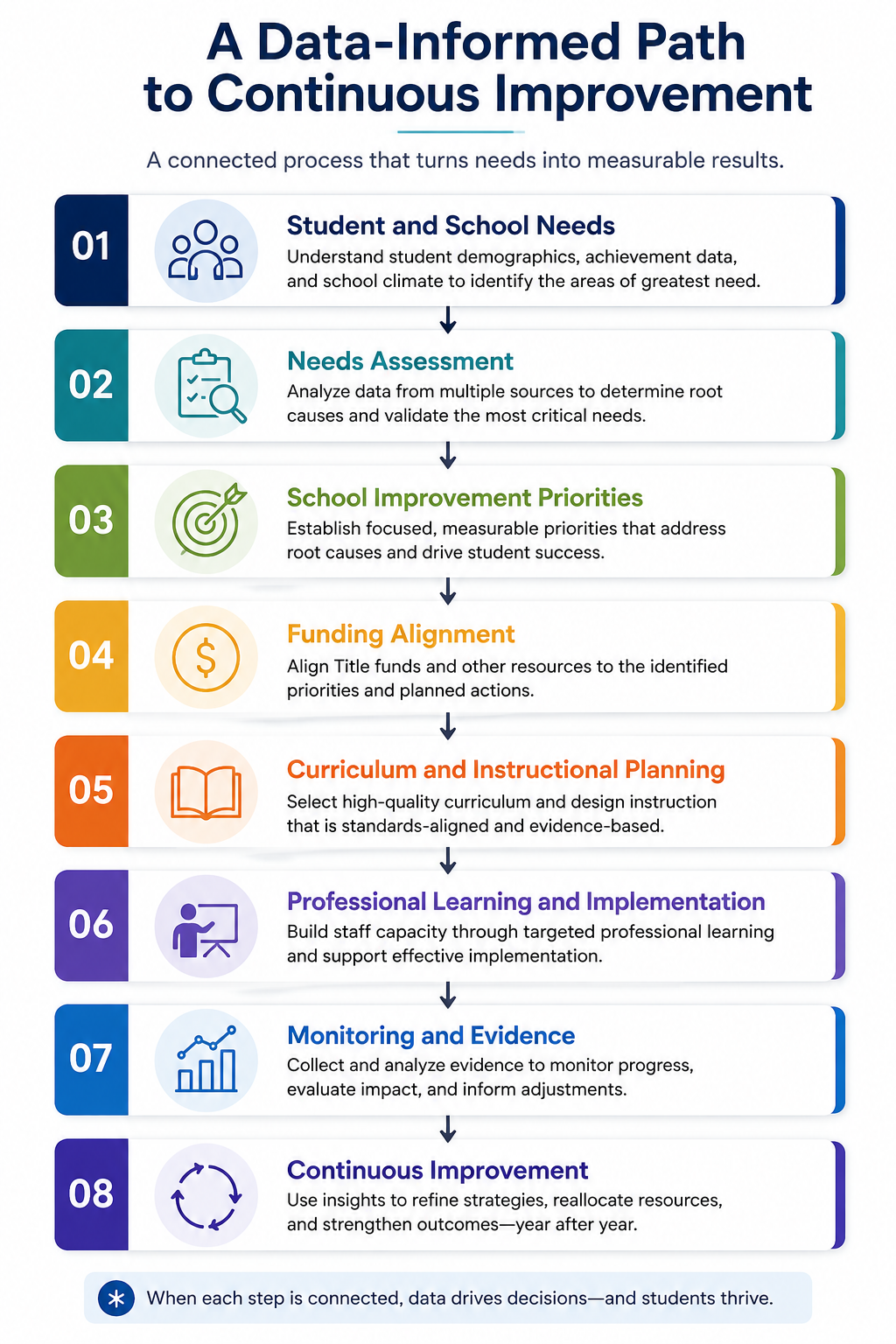
How School Leaders Can Build a More Strategic Title Fund Plan
The most effective approach is to treat federal funding as one component of a larger school improvement system. A strong planning cycle might look like this. This approach creates stronger connections between financial decisions and educational outcomes. It also helps prevent initiative overload. That is a much more strategic question.
Frequently Asked Questions About Title Funds
What are Title Funds?
Title Funds are federal education funds authorized under the ESEA. The term commonly refers to programs such as Title I, Part A; Title II, Part A; Title III, Part A; and Title IV, Part A. Each program serves a different educational purpose and has its own requirements.
What is Title I funding used for?
Title I, Part A provides financial assistance to LEAs and schools serving communities with higher concentrations of students from low-income families. The program supports efforts to improve educational opportunities and academic outcomes for eligible students.
What is Title II funding used for?
Title II, Part A supports teacher and school leader effectiveness. Activities can include professional development, recruitment, induction, retention and leadership development when they meet applicable program requirements.
What is Title III funding used for?
Title III, Part A supports English learners in acquiring English proficiency and meeting challenging academic standards. It also supports enhanced educational opportunities for eligible immigrant children and youth.
What is Title IV funding used for?
Title IV, Part A supports well-rounded educational opportunities, safe and healthy learning environments and effective use of technology, subject to applicable requirements.
Can Title Funds be used for curriculum materials?
Potentially, depending on the specific program, the purpose of the materials, the students or educators served, and applicable federal, state and district requirements. Schools should evaluate each expenditure individually rather than assuming that all curriculum materials qualify.
Can Title Funds pay for curriculum management software?
There is no blanket rule stating that curriculum management software is allowable under every Title program. The answer depends on the specific funding program, purpose of the expenditure, eligible beneficiaries and applicable requirements.
School leaders should consult their district or state federal programs and fiscal administrators before charging software to federal funds.
Can Title II funds support PLCs?
Potentially. PLCs may form part of an allowable professional learning or educator effectiveness activity when the activity meets Title II requirements. Schools should evaluate the specific PLC activity rather than assuming that every PLC-related expense qualifies.
Can Title Funds support teacher professional development?
Yes, professional learning is an important component of several federal education programs. Title II, Part A in particular provides support for activities designed to improve educator effectiveness.
Can private schools receive Title Funds?
Eligible private school students, teachers and other educational personnel may receive equitable services under certain ESEA programs. However, the federal funds generally are not simply transferred to private schools. Specific consultation, administration and public-control requirements apply.
What does supplement not supplant mean?
It generally means that federal funds should supplement, rather than replace, state and local resources that would otherwise have been available. The precise requirements differ by program, so schools should consult the applicable federal and state guidance before making funding decisions.
Who manages Title Funds?
Title Funds typically flow through federal, state, and local education agencies. District-level administrators often play a major role in planning, budgeting, compliance, procurement, and reporting. The extent of school-level control varies by district and program.
12. Can Title Funds be used for technology?
Some Title programs can support technology-related activities. Title IV, Part A specifically includes effective use of technology as one of its three major areas. However, technology purchases still need to meet the applicable program requirements and should be connected to an appropriate educational purpose.
Where should school leaders go for current Title Fund guidance?
School leaders should begin with the U.S. Department of Education and their state educational agency. They should also consult their district's federal programs, finance, grants management and procurement teams. Because requirements and guidance can change, current official sources should take precedence over general articles or third-party summaries.
Do Title Fund rules vary by state?
Yes. The underlying federal programs are established through federal law, but states and LEAs can differ in how they administer those programs, including application processes, allocations, guidance, monitoring, transferability, reimbursement and local approval requirements. Florida, Texas and Arizona, for example, each maintain their own state-level federal program and grants-management structures. School leaders should consult their state education agency and LEA for current requirements.
Final Thoughts: From Funding Management to Instructional Strategy
Title Funds can provide valuable resources for K-12 schools. But the most effective use of those resources requires more than understanding the names of the programs. School leaders need to understand the connection between funding, student needs, educator capacity, curriculum, instruction, implementation and outcomes.
Title I can help address academic needs and educational opportunity.
Title II can strengthen teachers and school leaders.
Title III can support English learners and eligible immigrant students.
Title IV can broaden educational opportunities, strengthen conditions for learning and support effective use of technology.
The programs are different. The planning process can still be connected.
When school leaders begin with a documented need, identify the appropriate funding source, verify allowability, plan for implementation, connect the work to curriculum and instruction and evaluate results, Title Funds become more than a budget category. They become a strategic resource for school improvement.
For principals, curriculum directors and administrators, that is ultimately the opportunity to make every funded initiative part of a coherent system for improving teaching and learning.
Recommended Resources for School Leaders
Because federal education requirements can change, school leaders should use current primary sources when making funding decisions.
U.S. Department of Education: Title I, Part A
Current information on Title I, Part A programs, eligibility, funding, and requirements.
U.S. Department of Education: Title II, Part A
Information on supporting effective teachers and school leaders, including professional development and educator effectiveness.
U.S. Department of Education: Title III, Part A
Information on English language acquisition and services for eligible English learners and immigrant students.
U.S. Department of Education: Title IV, Part A
Information on well-rounded education, safe and healthy students, and effective use of technology.
U.S. Department of Education: ESEA Equitable Services
Guidance on services for eligible private school students and educators under applicable ESEA programs.
U.S. Department of Education: Supplement Not Supplant Guidance
Federal guidance on Title I, Part A supplement-not-supplant requirements.
(Disclaimer: This article is intended for educational and planning purposes. Federal education funding requirements can change. Allowability depends on the specific program, expenditure, circumstances, federal requirements, state guidance and local policies. School leaders should consult their appropriate state and district officials before making funding or compliance decisions.)