
(Disclaimer: This is a policy summary, not legal advice. Details are based on public announcements as of the date above.Terms may change before the November 1, 2026 effective date. Please confirm specifics with Microsoft, the AFT/UFT or your state education agency.)
Key Takeaways
What's happening: Ten contractually enforceable AI protections for K-12 schools spanning privacy, safety, transparency, equity and accountability; become available to every US district on November 1, 2026.
Who's behind it: Negotiated jointly by the AFT, the UFT and Microsoft; described by union leaders as the first agreement of its kind.
What led here: Over a year of groundwork, starting with the AFT's National Academy for AI Instruction (July 2025) and a wave of state activity. More than 35 states had published K-12 AI guidance by mid-2026
What it doesn't replace: District-level rules. NYC and LAUSD have both restricted student-facing AI for younger grades independently of this standard.
What's next: The AFT is in talks to bring OpenAI and Anthropic under the same ten protections, aiming for an industry-wide baseline rather than a Microsoft-only rule.
What this post is: A preview. A full breakdown of the standard's provisions follows once it takes effect.
How did we get here? A year and a half of K-12 AI policy activity
It's easy to read the November 1 rollout as a single event. It isn't. It's the visible endpoint of roughly a year and a half of organizing by the country's second largest teachers' union.
In July 2025, the AFT launched the National Academy for AI Instruction with Microsoft as lead partner, OpenAI as founding partner and Anthropic also contributing to a $23 million, five-year initiative aimed at training AFT's 1.8 million members, starting with K-12 educators, out of a dedicated facility in Manhattan. Microsoft committed roughly $12.5 million, OpenAI $8 million plus in-kind engineering support and Anthropic $500,000 in first-year funding.
AFT President Randi Weingarten framed the effort around a specific worry that teachers would end up as "spectators on the sidelines" of AI adoption rather than the people directing how it's used in their classrooms. That framing turned into a specific ask in May 2026. In a speech titled "Devices Down, Eyes Up, Hands-On," Weingarten called for a total screen ban from kindergarten through second grade, a ban on student-facing AI in elementary school, and a ban on social companion chatbots for students under 16 - and, alongside those, an enforceable data privacy standard. The first three are usage restrictions, the kind a district or a state imposes.
The fourth is a vendor obligation and it is the one the AFT could only get by negotiating directly with a company. That split explains why the next eighteen months produced two different kinds of rules and why the November 1 standard covers only one of them.
Over the following year, state legislatures got busy. More than 1,500 AI-related bills were introduced nationwide, with close to 100 of them touching K-12 student use directly. By mid-2026, over 35 states plus Puerto Rico had published some form of official AI guidance for schools. Ohio became the first state to convert AI guidance into a statutory duty. Under House Bill 96, which added Section 3301.24 to the Revised Code, every traditional district, community school and STEM school had to adopt a written AI policy by July 1, 2026 - a deadline that has now passed. The statute requires that a policy exist; it does not dictate what the policy says, and it does not require districts to teach AI or use AI tools.
At the same time, some of the loudest signals came from the district level, moving in the opposite direction. New York City opened the 2026-2027 school year with a one-year moratorium on student-facing generative AI for grades pre-K through 8 while rolling out twice-yearly AI literacy instruction for high schoolers and piloting supervised AI use in select high school settings. Los Angeles Unified, the second-largest district in the US, arrived at a similar place by a different route. Its restriction was implemented administratively rather than by board vote.
The district uses firewall and web-filtering software to block AI as a content category, which covers both standalone AI services and AI features embedded in Google Workspace. The committee will bring permanent policy recommendations to the board by the end of the 2026-27 school year.
That restriction applies to school-issued devices only; students can still reach these tools on personal devices. New York's ban, by contrast, explicitly names companion chatbots as prohibited at every grade level, on top of its broader pre-K-8 restriction.
The push-pull is not between the union and the districts. It runs through the framework itself: restrict the youngest students, teach the oldest ones to think critically about the tools, and in both cases decide locally. What none of those local decisions can reach is how a vendor behaves - what it collects, what it trains on, what it does with the data after a contract ends. That is the gap the AFT, UFT and Microsoft negotiated to fill.
What are the protections in the K-12 AI Safety Standard?
1. No training on student or educator data
Student, educator and customer data cannot be used to train or improve an AI model, apart from a narrow safety and security exception.
2. Data minimization by design
Products are built to collect only what they need. Tracking, profiling, biometric data, persistent memory and other higher-risk features come with added limits and review.
3. Customer data ownership
Districts and students own their own data outright. It cannot be sold or used for advertising or product development and districts control export, retention and deletion.
4. Human oversight and explainability
AI is built to support decisions, not make them. High-risk decisions require human review and AI "companions" are prohibited outright. NYC's own moratorium echoes this directly, naming companion chatbots as banned at every grade level; LAUSD's device-level block of chatbots and AI assistants points the same direction, even though it isn't framed the same way.
5. Real accountability
Providers must maintain relevant certifications, report data breaches within 72 hours and fix violations or AI use is paused or ended entirely.
6. Security that matches the stakes
Data must be encrypted, access-controlled, independently tested and covered by incident-response plans , extending to any subprocessors involved.
7. Meaningful consent and transparency for families
Families receive clear, plain-language guides explaining how the AI products work and what privacy, safety and security protections are in place. This mirrors a broader pattern in state guidance.
Alabama's AI Policy Template, released in June 2024, is one early example. It recommends AI governance committees and human-in-the-loop oversight. It is a template for districts to build from, not a mandate.
8. Equity, accessibility and inclusion
Products must be accessible and fair. Providers are required to disclose and fix performance gaps, offer equal features across contexts and fund an independent study of their tools' real-world impact. This is the protection with the least public attention so far. State guidance documents flag it consistently but concrete enforcement mechanisms are still thin.
9. No feature creep and no vendor lock-in
Districts control material, new features and any new use of their data, receive advance notice of changes and can export their data and switch providers freely.
10. Long-term data responsibility
Data is kept only as long as needed. The bans on training and selling data are permanent. In addition, deletion and breach-notification duties continue even after a contract ends.
What makes November 1 worth watching isn't that these 10 aspects are new ideas, most of which already existed somewhere in state guidance. It's just that, for the first time, they're being written into an actual contract, with breach consequences, rather than left as a policy recommendation a district can choose to follow.
What happens next for the K-12 AI Policy?
Two things are still genuinely open. First, whether OpenAI and Anthropic adopt the same 10 protections. The AFT says those conversations are underway but nothing is finalized. Second, whether this becomes a de facto national baseline or one vendor's standard among several competing state and district rules. Weingarten has said she wants more companies to sign, naming OpenAI and Anthropic. Neither has claimed the standard supersedes state or district authority. And none of the rules already on the books defer to it. Ohio's mandate, California's statewide model policy, (which the Department of Education published under the SB 1288 deadline of July 1, 2026) and New York City's moratorium are all running on their own timelines. In fact, none of them defer to a Microsoft agreement to set their terms.
Founder's note:
“It is heartening to see real action around AI policy in K-12 education. Although time and real-life implementation are the only things that will prove efficacy, I feel much more optimistic than before about the thoughtful way forward. Regardless of the bar set by others, we at Edusfere, remain committed to the highest standards possible regarding intentional and safe AI integration. Bringing real value to the lives of teachers and students remains our core focus.”
Grant Wootten, CEO, Edusfere
We'll be back with a closer look once the standard actually takes effect on November 1, what's actually enforceable versus aspirational, how it interacts with state-level rules already on the books and what it changes (or doesn't) for the day-to-day work of lesson planning and curriculum documentation.
For now, most published state and union efforts point to a genuine shift in K-12 AI oversight, from platforms like Edusfere down to the individual classroom, from a landscape of scattered guidance toward something closer to an enforceable floor.
How does the national standard compare to NYC's and LA's own rules?
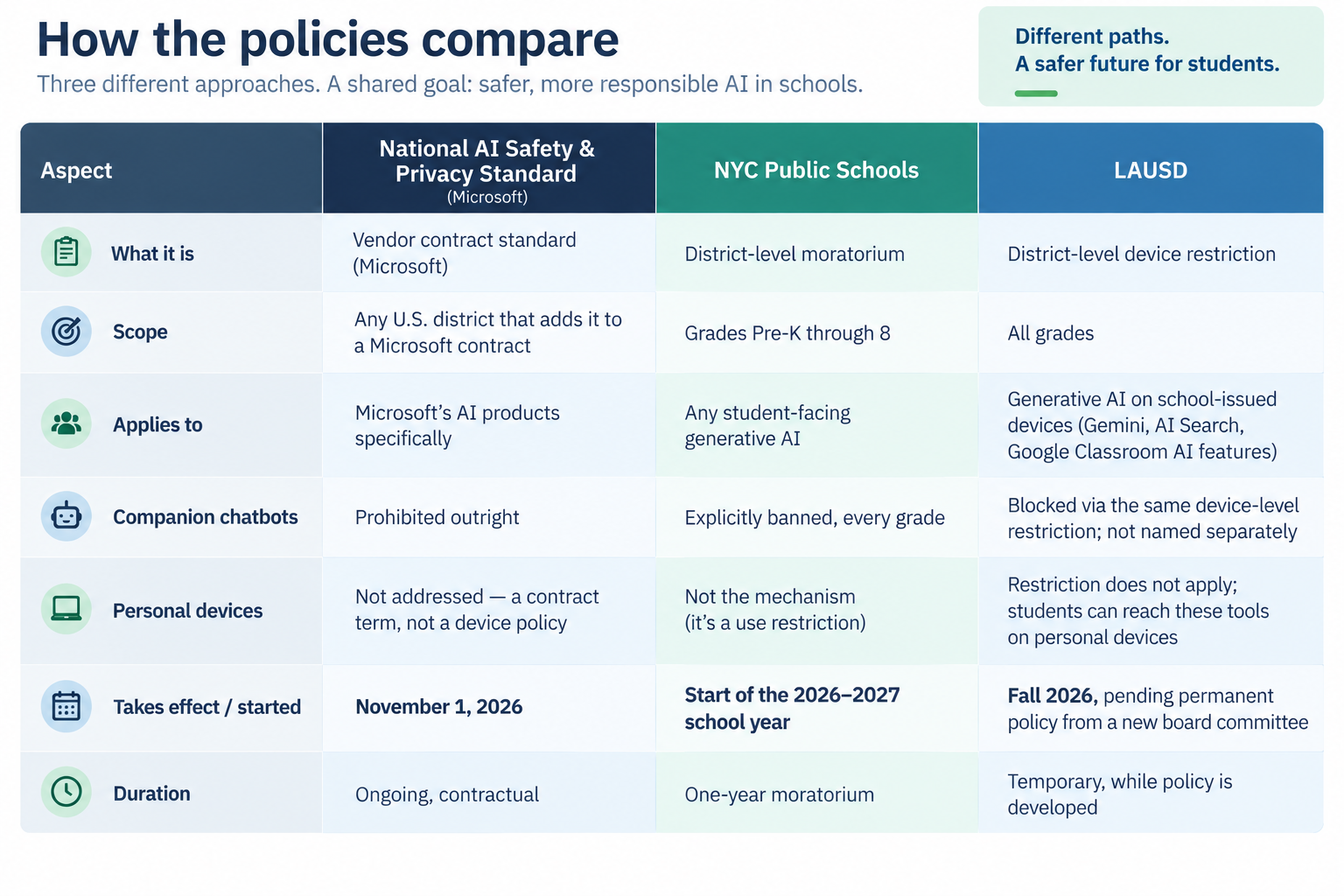
These are three different kinds of rules, operating at different levels and none of them cancels out the others
In short, the national standard sets a floor for how a vendor must behave, wherever its products are used. NYC and LAUSD are exercising their own authority on top of that, deciding whether and how AI reaches a classroom at all, independent of what any vendor promises.
Frequently Asked Questions (FAQs)
When does the National AI Safety & Privacy Standard take effect?
Microsoft has said the protections will be available to every US school district starting November 1, 2026. Districts can add the terms to new or existing contracts without a full renegotiation.
Does this standard apply to every state or only districts that use Microsoft?
As written, it's specific to Microsoft's contracts with schools. The AFT has said it is in discussions with OpenAI and Anthropic to adopt the same ten protections, which would extend the standard beyond one vendor but that isn't finalized.
How does this relate to state AI laws and district-level bans already in place?
It operates alongside them, not in place of them. States like Ohio have their own mandated policy requirements and districts like New York City and Los Angeles have imposed their own restrictions on student-facing AI independent of this agreement.
Is this the first enforceable AI standard for K-12 schools?
Union and Microsoft leadership have described it as "first of its kind" specifically because the protections are contractually, not just voluntarily, enforceable, with reporting deadlines and consequences for violations.
Where can I read the full standard?
Microsoft has published a public fact sheet summarizing the ten protections and the AFT has published the full agreement text.
(Disclaimer: This is a policy summary, not legal advice. Details are based on public announcements as of the date above.
Terms may change before the November 1, 2026 effective date. Please confirm specifics with Microsoft, the AFT/UFT or your state education agency.)