

Digital technology has transformed how K-12 schools manage curriculum, plan instruction, communicate, assess learning and support teachers. The challenge for school leaders is no longer whether technology has a place in education. It is determining whether the technology ecosystem is helping educators work more effectively or creating another layer of complexity. This is where tool sprawl becomes a concern.
Tool sprawl in K-12 education occurs when schools accumulate a growing number of digital platforms and applications that serve different, overlapping or disconnected purposes. In the context of instruction, a teacher may use one system for curriculum mapping, another for standards, another for lesson planning, a shared drive for instructional resources, an LMS for assignments and a separate platform for assessment.
Each tool may serve a legitimate purpose. The challenge arises when teachers and curriculum leaders have to connect those systems themselves.
Recent data illustrates the scale of the broader edtech landscape. Instructure's 2026 EdTech Top 40 analyzed Learning Tools Interoperability (LTI) activity across more than 12.6 million K-12 users between September 2025 and April 2026. The report found that districts had access to an average of 3,001 digital tools, while individual students and educators interacted with approximately four LTI tools on average.
The issue, therefore, is not simply how many tools a school has. The more important question is whether curriculum management, curriculum mapping and lesson planning operate as connected parts of the instructional process. Or as separate activities that teachers and leaders must reconcile manually?
What is Tool Sprawl in K-12 Education?
Tool sprawl is the accumulation of digital platforms across a school or district without sufficient integration, governance or clarity about how each tool contributes to the wider instructional ecosystem. In K-12 education, tool sprawl can emerge gradually.
A teacher may plan lessons in Google Docs or Planbook, distribute work through Google Classroom or Canvas, record information in a separate SIS and communicate with families through ClassDojo or Seesaw. This accumulation of disconnected platforms is commonly described as tool sprawl. Over time, the technology environment becomes more extensive without necessarily becoming more connected.
For teachers, this can result in a workflow such as:
Curriculum map → Standards → Unit plan → Lesson plan → Resources → LMS → Assessment
The information may be relevant at every stage but the systems may not communicate with one another. This creates a critical distinction for school leaders. A school can have extensive digital infrastructure without having a connected curriculum system. That distinction is particularly important when evaluating curriculum management software.
The purpose of curriculum management should not simply be to provide another place to store curriculum documents. It should help schools connect curriculum expectations with the work teachers do when planning and delivering instruction.
Why Is Tool Sprawl a Curriculum Management Problem?
Curriculum management encompasses much more than maintaining curriculum documents. Effective curriculum management helps schools organize and oversee what students are expected to learn, how learning progresses across grades and subjects, how standards are addressed and how classroom instruction reflects curriculum expectations.
When the underlying information is distributed across multiple systems, curriculum leaders may have access to all the necessary data but still struggle to see the full picture. For example:
- The curriculum map may show where a standard is introduced.
- The lesson plan may show how a teacher intends to address it.
- The resource platform may contain the instructional materials.
- The assessment platform may contain evidence of student learning.
- The LMS may show what students were assigned.
Each system provides a piece of the instructional picture. The leadership challenge is connecting those pieces. This is why modern curriculum management should focus not only on documentation but also on visibility, alignment, continuity and institutional knowledge. A connected curriculum management system allows schools to move from maintaining separate records toward understanding how curriculum is being planned and implemented.
How Does Tool Sprawl Affect Lesson Planning?
Lesson planning is where curriculum intent becomes classroom practice.
Teachers must consider curriculum goals, standards, unit progression, instructional strategies, resources, student needs, differentiation and assessment when developing a lesson. When these elements are distributed across disconnected platforms, the planning process can become unnecessarily fragmented.
1. Teachers May Have to Recreate the Same Information
Every time information is manually transferred, there is an opportunity for inconsistencies to emerge. A standard may be updated in one place but remain unchanged in another. A lesson may be revised without the corresponding curriculum documentation being updated. A more connected approach allows information to be reused throughout the instructional workflow.
2. Lesson Planning Can Become Separated From Curriculum Mapping
Curriculum mapping and lesson planning serve different purposes. But they should inform one another. Curriculum mapping provides the broader view, i.e., what students should learn, when they should learn it, how learning progresses and where standards are addressed.
Lesson planning operates at a more immediate level: what a teacher will do with students during a particular lesson or sequence of lessons. When the two are disconnected, teachers may have to interpret the curriculum map separately every time they plan. When they are connected, the curriculum map becomes a working reference point for lesson planning rather than a static document reviewed only during curriculum audits. That shift matters.
Curriculum mapping should inform daily instruction, not simply document it after the fact.
3. Curriculum Leaders Can Lose Visibility Into Implementation
School leaders need to understand not only what the curriculum intends to accomplish but also how that curriculum is being translated into classroom practice. Disconnected lesson-planning systems make this more difficult. A curriculum director may be able to access curriculum maps but still have limited visibility into how teachers are translating those maps into lessons.
This creates an important distinction. Curriculum documentation tells schools what has been recorded. Curriculum visibility helps leaders understand how the pieces connect. For school leaders, the objective should be greater visibility without requiring teachers to produce additional layers of documentation.
How Does Tool Sprawl Affect Teacher Workload?
Technology is often introduced to save teachers time. Yet a poorly connected technology ecosystem can have the opposite effect.
Education Week reported in January 2026 that a typical U.S. teacher works approximately 54 hours per week, with just under half of that time devoted directly to teaching. The remaining time includes responsibilities such as lesson planning, grading, meetings and communication. This makes the efficiency of instructional workflows particularly important.
When evaluating lesson planning software or curriculum management technology, school leaders should consider more than the number of features available. They should ask:
- Does the platform reduce duplicate data entry?
- Can teachers access curriculum information while planning lessons?
- Can lesson plans remain connected to standards and units?
- Does the platform preserve existing teacher work?
- Can curriculum leaders see relevant information without requesting additional reports?
- Does the technology simplify the workflow or add another step?
A platform should not simply digitize an existing process. It should help make the process more coherent and sustainable.
How Does Curriculum Mapping Support Better Lesson Planning?
Curriculum mapping provides the structural context that lesson planning needs. A curriculum map can help teachers understand:
- What students are expected to learn
- How learning progresses within a subject
- Which standards are addressed
- Where concepts are introduced, developed, and reinforced
- How individual lessons fit within broader units
- Where resources and assessments support the curriculum
Without that context, lesson planning can become highly individual. Teachers may create strong lessons, but the school may have limited visibility into how those lessons contribute to the larger curriculum. When curriculum mapping and lesson planning are connected, teachers can plan with greater awareness of the broader instructional sequence. This is particularly valuable in schools where multiple teachers teach the same subject or grade level.
Instead of each teacher maintaining an isolated collection of lesson plans, the school can build a shared body of curriculum knowledge that evolves over time.
What are the Signs of Tool Sprawl in Curriculum and Lesson Planning?
The number of tools alone does not determine whether a school has tool sprawl. The more meaningful indicators are duplication, fragmentation, unnecessary administrative work and lack of visibility.
Here are the 5 signs school leaders should look for:
1. Teachers Maintain Multiple Versions of the Same Information
If curriculum objectives, standards or lesson details appear in several different systems, the school may be maintaining unnecessary duplication.
2. Teachers Frequently Move Information Between Platforms
Repeated copying and pasting is often an indication that two important parts of the instructional workflow are not adequately connected.
3. Curriculum Maps Are Reviewed Separately From Lesson Planning
If curriculum mapping happens during periodic curriculum reviews while lesson planning happens somewhere else every day, the school may be missing an opportunity to make curriculum maps more useful to teachers.
4. Teachers Depend on Personal Workarounds
Spreadsheets, personal folders, shared documents, and unofficial applications may indicate that teachers are filling gaps in the formal curriculum management workflow. Those workarounds should not automatically be viewed as a problem. They can provide valuable insight into what teachers need from the school's systems.
5. Leaders Have Plenty of Data but Limited Context
Schools may have dashboards, reports, lesson plans, curriculum maps, assessment results and usage data. But if these pieces cannot easily be connected, more data does not necessarily create greater instructional visibility.
How Should K-12 School Leaders Address Tool Sprawl?
The answer is not to eliminate every digital tool. Schools have legitimate reasons to use different technologies for different purposes. The goal should be to create an intentional instructional technology ecosystem in which each tool has a clear role and the most important curriculum information remains connected.
Start With the Instructional Workflow
Before introducing another platform, map the current process. You can begin with asking the following questions:
- Where does curriculum information begin?
- Where are standards selected and aligned?
- Where are units developed?
- Where are lesson plans created?
- Where are resources stored?
- Where are assessments documented?
- Where can curriculum leaders review implementation?
- Where is information entered more than once?
This exercise often reveals that the primary challenge is not insufficient technology. It is insufficient connection between existing technology.
2. Evaluate Curriculum Management Software as Part of the Larger Ecosystem
When selecting curriculum management software, school leaders should evaluate how the platform fits into the wider instructional environment.
A useful evaluation framework includes five areas.
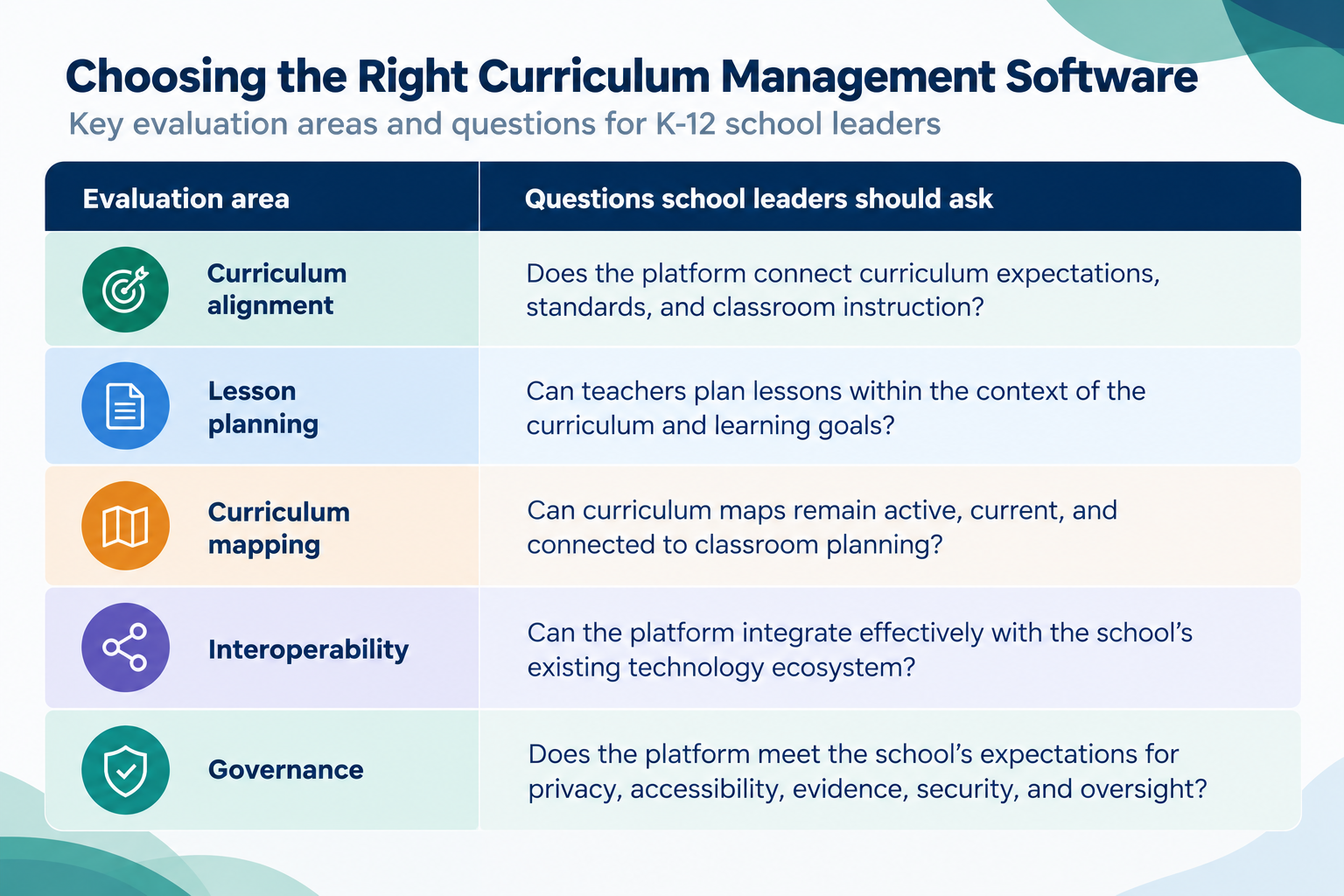
This broader approach is increasingly relevant to K-12 technology procurement.
CoSN's 2025 State of EdTech District Leadership report found that 59% of surveyed districts used an approved-app list, compared with 42% two years earlier. The organization also identified interoperability, data privacy and the ad hoc adoption of free digital tools as important district concerns.
The direction is clear: technology decisions are increasingly being evaluated as part of an ecosystem rather than as isolated purchases.
What Role Should AI Play in Lesson Planning?
Generative AI has introduced another layer to the conversation around lesson planning. AI can help teachers organize ideas, adapt materials, generate drafts, summarize information and reduce repetitive documentation. But schools should distinguish between AI assistance and AI-directed instruction. The growing use of AI makes an important leadership question more pressing. How can schools use AI without creating another disconnected layer in the instructional workflow?
The answer should begin with purpose. AI should be evaluated according to whether it:
- reduces repetitive work
- supports teacher expertise
- preserves instructional context
- keeps educators in control of decisions
- works within established curriculum workflows
- protects student and teacher data
AI adoption should not become another reason for teachers to move between disconnected platforms.
Edusfere's Approach to AI in Curriculum and Lesson Planning
Edusfere's philosophy is grounded in a simple principle:
AI should support teacher expertise, not replace it.
A teacher brings knowledge of students, classroom context, instructional history, learning needs, and professional judgment that cannot simply be delegated to an AI system. AI can assist with organization and documentation. But the teacher remains responsible for deciding what students need to learn and how that learning should be approached.
This principle is reflected in Edusfere's approach to AI-assisted lesson planning. Rather than positioning AI as an autonomous lesson generator, Edusfere uses AI to help structure and document teacher-created instructional thinking. Its Lesson Importer also helps bring existing teacher-created lessons into the curriculum environment. The distinction is important:
Teacher expertise → AI assistance → Connected curriculum
rather than:
AI generation → isolated lesson → disconnected curriculum
For school leaders, this provides a more measured approach to AI adoption. One that prioritizes instructional context and professional judgment alongside efficiency.
What Does a Connected Curriculum and Lesson Planning Workflow Look Like?
A connected instructional workflow does not require every school function to exist inside a single platform. Instead, it ensures that the information most important to curriculum and instruction remains connected. A teacher should be able to move naturally through:
- Curriculum goals: What should students learn?
- Standards alignment: Which standards or learning expectations does the lesson address?
- Curriculum mapping: Where does this learning sit within the broader scope and sequence?
- Unit planning: How does the lesson contribute to the unit's learning progression?
- Lesson planning: What instructional approach will the teacher use with this particular group of students?
- Resources: Which materials support the lesson?
- Assessment: How will the teacher determine whether students have understood the intended learning?
- Curriculum review: How can school leaders understand implementation and identify opportunities for refinement?
This creates a continuous relationship between curriculum mapping and lesson planning, rather than treating them as separate administrative activities. The result is a curriculum system that can evolve with classroom practice.
5 Ways K-12 Schools Can Reduce Tool Sprawl
1. Map the Current Curriculum and Lesson-Planning Process
Document where curriculum maps, standards, lesson plans, resources and assessments currently live. Identify where teachers have to duplicate information or switch between systems.
2. Define the Role of Every Core Platform
Every technology platform should have a clearly defined purpose. If two systems perform essentially the same function, determine whether both are necessary.
3. Prioritize Interoperability
A platform should fit into the school's wider technology environment. Interoperability should be considered before implementation, rather than treated as a technical issue after adoption.
4. Evaluate Teacher Workload
Ask teachers where technology saves time and where it creates additional work. The people using the system every day are often the best source of information about workflow friction.
5. Establish a Shared Curriculum Source of Truth
Curriculum maps, standards, units, lesson plans and related instructional knowledge should not exist as isolated pieces of information. Schools benefit when teachers and curriculum leaders can work from a connected curriculum environment.
Why Curriculum Management Is Becoming More Important
The growth of educational technology does not reduce the need for curriculum management. It increases it. As schools adopt more digital resources, they need stronger ways to understand how those resources fit within curriculum expectations and classroom instruction. This is particularly important as schools navigate AI.
The question is no longer simply whether a teacher can generate a lesson in seconds. The more meaningful questions are:
- Does the lesson align with the curriculum?
- Does it address the intended standards?
- Does it fit within the progression of learning?
- Does it reflect the needs of the students?
- Can the teacher explain and adapt the instructional decisions?
- Can the school preserve and build upon that knowledge?
Technology can accelerate parts of the process. But curriculum management provides the structure that keeps the process coherent.
Connecting Curriculum Mapping and Lesson Planning with Edusfere
Edusfere is built around the idea that curriculum management should be an active part of instructional practice, not simply a repository for curriculum documents. By connecting curriculum mapping, standards alignment, lesson planning and instructional resources, Edusfere helps schools create a more continuous relationship between what the curriculum intends and what happens in the classroom.
Teachers can plan within the context of their curriculum. Curriculum leaders can maintain greater visibility into curriculum implementation. School administrators can work from a more organized view of curriculum knowledge. And as teachers create and refine lessons, that knowledge can become part of the school's broader curriculum system rather than remaining isolated in individual files.
The goal is not to eliminate every technology platform a school uses. It is to ensure that the core curriculum and instructional workflow remains connected.
Key Takeaways for K-12 School Leaders
Tool sprawl is not fundamentally a problem of having too many tools. It is a problem of having too many disconnected places where important instructional information lives.
1. Tool sprawl is a curriculum management issue.
When curriculum information is fragmented across systems, schools can lose visibility into how curriculum planning connects with classroom instruction.
2. Curriculum mapping should inform lesson planning.
A curriculum map becomes more valuable when teachers can use it as part of their everyday instructional planning rather than treating it as a static curriculum document.
3. Lesson planning should remain connected to the curriculum
Teachers need context around the standards, units, learning progression and expectations that inform individual lessons.
4. More technology does not automatically create better instructional workflows
Schools should evaluate technology based on its purpose, evidence, usability, interoperability, privacy and contribution to the wider instructional ecosystem.
5. Teacher time is an important measure of technology effectiveness.
A platform should reduce unnecessary administrative work rather than simply digitize or redistribute it.
6. AI should strengthen, not replace, professional judgment
AI can support organization and documentation. But teachers should remain central to instructional decisions.
7. Curriculum management provides the connective layer
When curriculum mapping, lesson planning, standards alignment and instructional knowledge remain connected, schools can build a more coherent and sustainable approach to curriculum and instruction.
Frequently Asked Questions (FAQs) about Tool Sprawl, Curriculum Management, and Lesson Planning
What is tool sprawl in K-12 lesson planning?
Tool sprawl in K-12 lesson planning occurs when teachers use multiple digital platforms for curriculum mapping, standards alignment, lesson planning, resources, assessment and documentation without sufficient integration between them. The result can be duplicated work, fragmented information and reduced curriculum visibility.
How does tool sprawl affect curriculum management?
Tool sprawl can make curriculum management more difficult because important information may be distributed across several platforms. Curriculum leaders may have access to curriculum maps, lesson plans, standards, resources and assessment data. But they often continue to have difficulty understanding how these elements connect.
How does curriculum mapping support lesson planning?
Curriculum mapping provides teachers with the broader instructional context for individual lessons. It can show where a lesson fits within a unit, which standards it addresses, what students have previously learned and how learning progresses over time.
What is the difference between curriculum mapping and lesson planning?
Curriculum mapping provides a broader view of what students should learn and how learning progresses across a course, grade level or subject. Lesson planning focuses on the specific instructional experiences a teacher will use to support that learning. The two processes serve different purposes but should inform one another.
Why should curriculum mapping and lesson planning be connected?
Connecting curriculum mapping and lesson planning helps teachers plan within the context of the school's curriculum. It also allows curriculum leaders to maintain greater visibility into how curriculum expectations are translated into classroom instruction.
Can curriculum management software reduce tool sprawl?
Curriculum management software can reduce fragmentation when it brings related workflows such as curriculum mapping, standards alignment, lesson planning and instructional resources into a connected environment. The objective is not necessarily to replace every platform a school uses but to reduce unnecessary duplication around core curriculum processes.
What should school leaders look for in curriculum management software?
School leaders should consider curriculum alignment, curriculum mapping capabilities, lesson planning, standards alignment, interoperability, usability, data privacy, accessibility, evidence of effectiveness and the platform's approach to AI. The most important consideration is how the platform fits into the school's broader instructional ecosystem.
How can schools reduce tool sprawl without limiting teacher innovation?
Schools can establish clear technology governance while leaving room for purposeful experimentation. An approved-app process, transparent evaluation criteria, teacher input and regular technology reviews can help schools distinguish valuable innovation from unnecessary duplication.
Can AI make tool sprawl worse?
Yes. If AI is introduced as another standalone application, it can add another destination to an already fragmented lesson-planning workflow. Schools should consider whether AI can be integrated into existing curriculum and lesson-planning processes instead.
Should AI generate lesson plans for teachers?
AI can assist teachers with planning, organization and documentation. But instructional decisions should remain grounded in educator expertise and curriculum context. Edusfere's approach is to use AI to support teacher-created instructional thinking rather than replace the teacher's professional judgment.
How can schools make lesson planning more efficient?
Schools can make lesson planning more efficient by connecting lesson planning with curriculum mapping, standards, units, resources and assessment. Reducing duplicate data entry and giving teachers access to relevant curriculum information within the planning workflow can also reduce unnecessary administrative work.
Build a More Connected Approach to Curriculum and Instruction
The next stage of K-12 edtech should not be defined by how many tools schools can adopt. It should be defined by how effectively technology supports curriculum coherence, teacher expertise and instructional practice.
For school leaders, that means looking beyond individual platforms and evaluating how the entire technology ecosystem supports the curriculum.
For teachers, it means spending less time moving information between systems and more time applying professional judgment to the students they teach. And for schools, it means treating curriculum knowledge as something that should remain connected, visible, adaptable and useful.
Edusfere brings curriculum mapping, lesson planning, standards alignment and instructional resources into a connected curriculum management environment. This helps schools move from fragmented planning to a more coherent approach to curriculum and instruction.
See how Edusfere can help your school connect curriculum management, curriculum mapping and lesson planning.